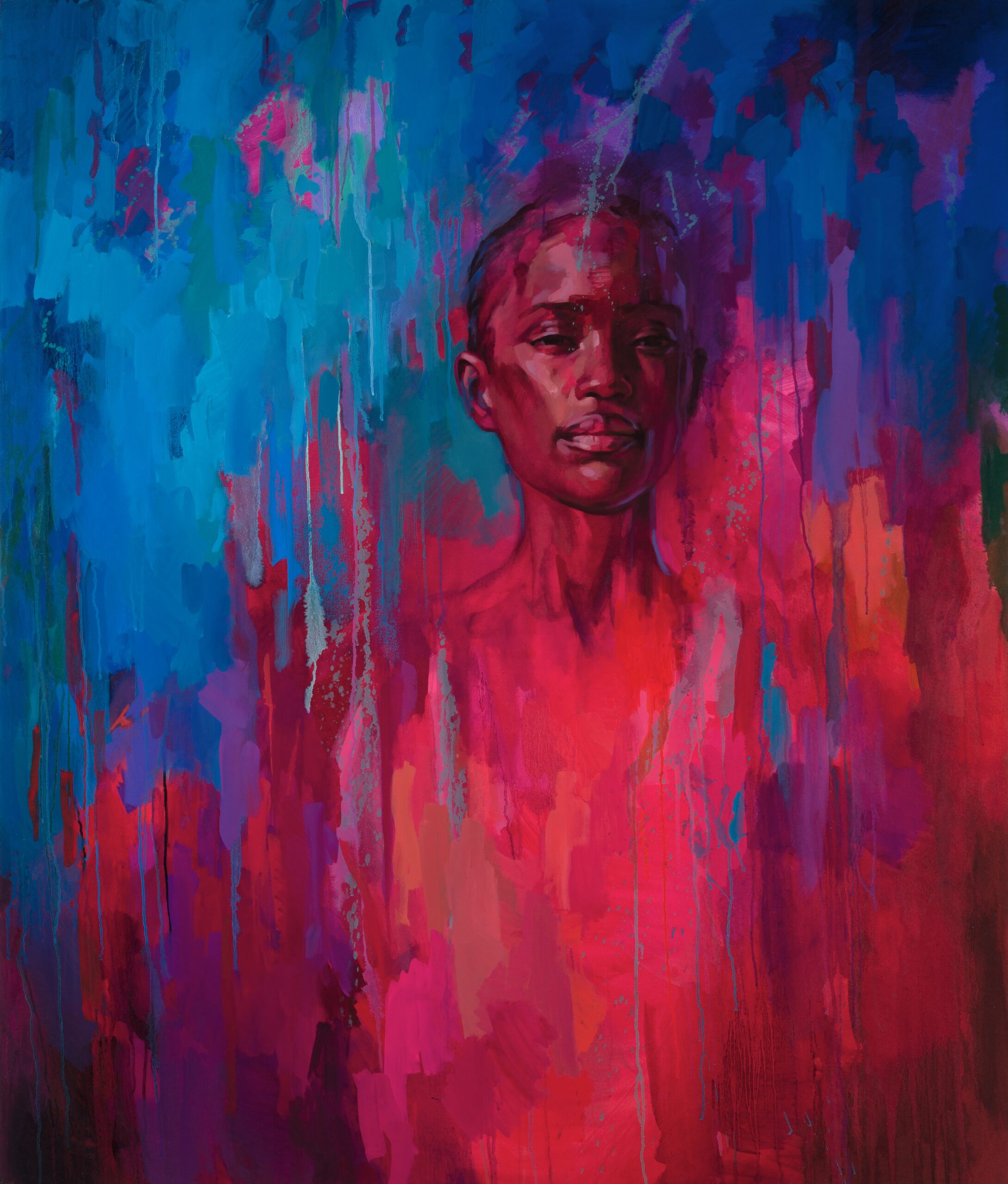
For any inquiries about work on display, please contact Gallery Manager, Amy Cook, at acook@abingtonartcenter.org.
Tag: exhibitions
Solo Series Spring 2026
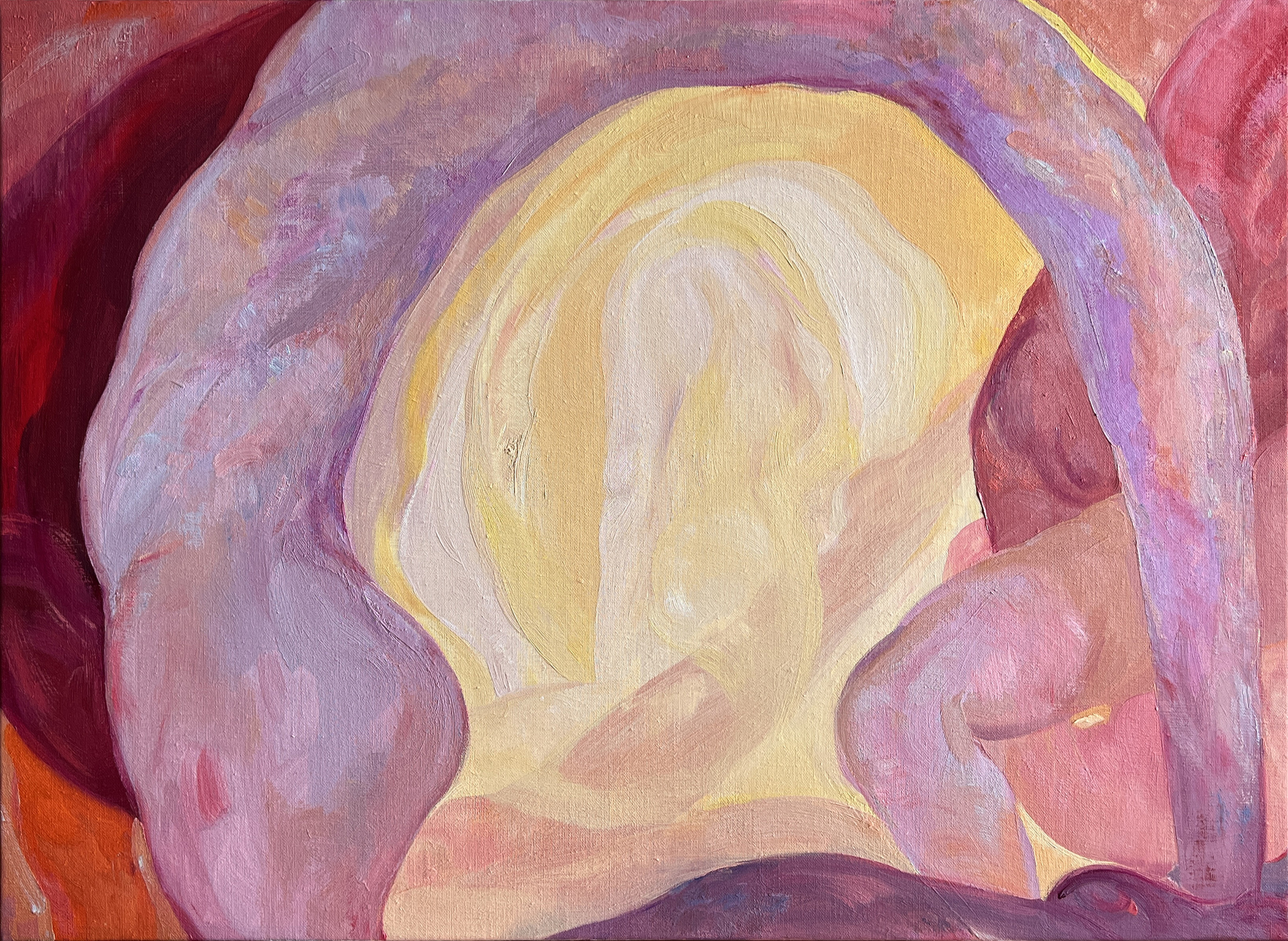
Untitled (Om in Yoga 2), 2023 | Guizi Gao | Oil on linen | $3,000
On View April 24 – June 1, 2026
Opening Reception | Friday, April 24 | 6:00p.m. – 8:00 p.m.
Artist Talk | Stephanie Manzi, Guizi Gao, & Ben Pranger | Wednesday, April 29 | 6:00 p.m. – 8:00p.m.
Featured Artists: Guizi Gao, Stephanie Manzi, and Ben Pranger
ARTISTS
Guizi Gao – Realm of Chaos
Kellner Gallery
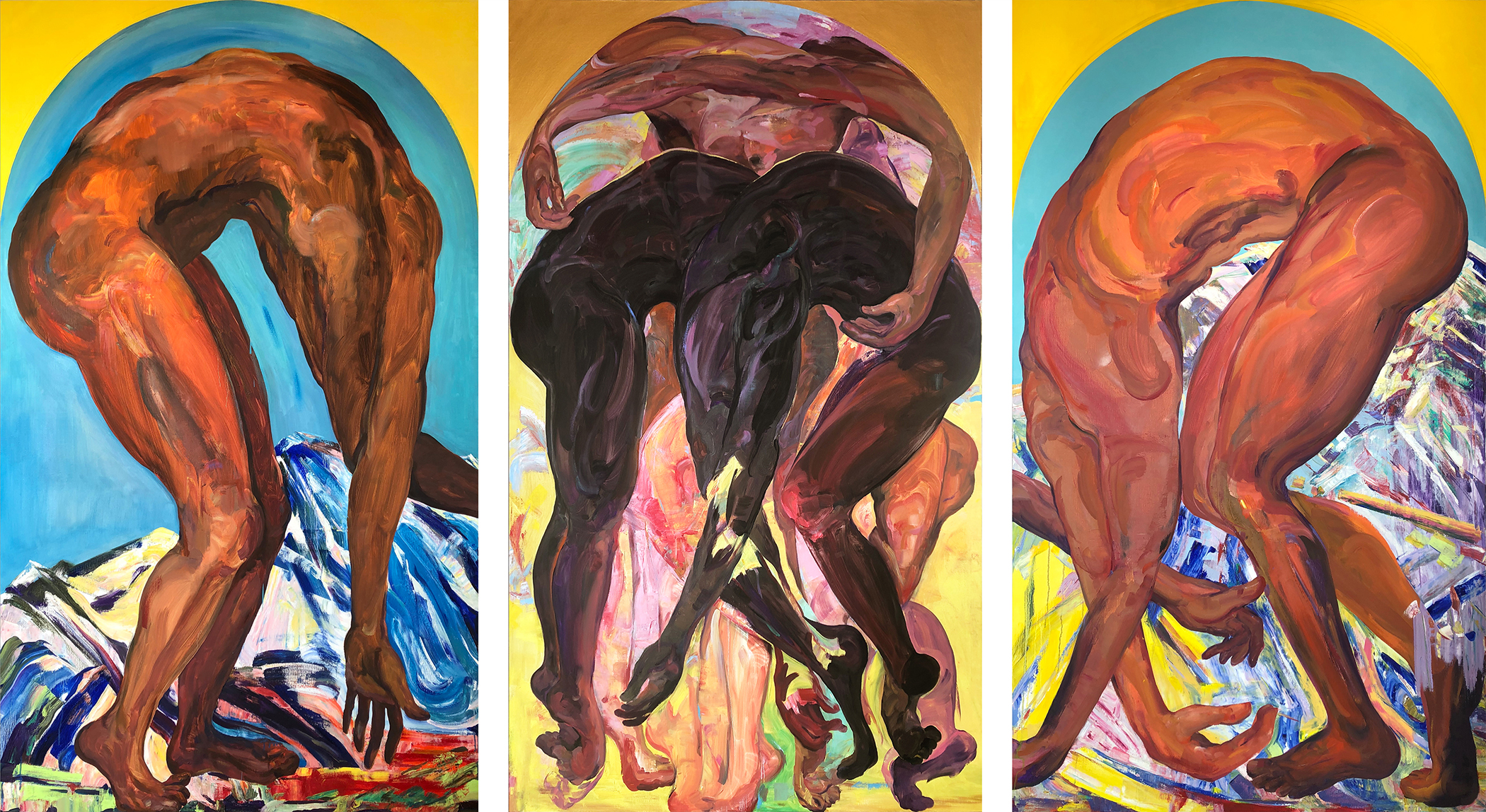
Guizi Gao is a figurative expressionist oil painter whose work explores the human body as a mutable vessel shaped by social, biological, and psychological forces. Working in large-scale oil painting, she fuses Renaissance and Baroque compositional structure with gestural distortion and layered, tactile surfaces. Influenced by the London School, particularly Francis Bacon and Jenny Saville, Gao treats paint as corporeal matter, building and erasing flesh-like forms. Her signature headless or obscured figures are stripped of fixed identity, transforming from portraiture into archetypal presences that carry social, emotional, and existential resonance.
Gao’s series Realm of Chaos – Amazing Grace are inspired by Daoist cosmology, tracing cycles of vital spirit descending into the body, awakening, self-tempering, and spiritual renewal. Figures dissolve into organic geometry, translucency, and childlike symbolic forms, reflecting the flow of qi气, resilience, and the natural ascent of the heart-mind. The works engage themes of womanhood, pregnancy, breastfeeding, loss, and rebirth, presenting the body as both intimate and universal while highlighting the delicate balance between vulnerability and strength.
Gao holds an MFA in Oil Painting from the China Academy of Art and completed graduate study at the Pennsylvania Academy of the Fine Arts. Her work has been exhibited internationally in the United States, China, France, the U.K., Japan, and Norway, earning Merit Prizes from the Salmagundi Club International Figurative Art Competition.
════════════════════════════════════
Stephanie Manzi – Net Change
Book Room Gallery
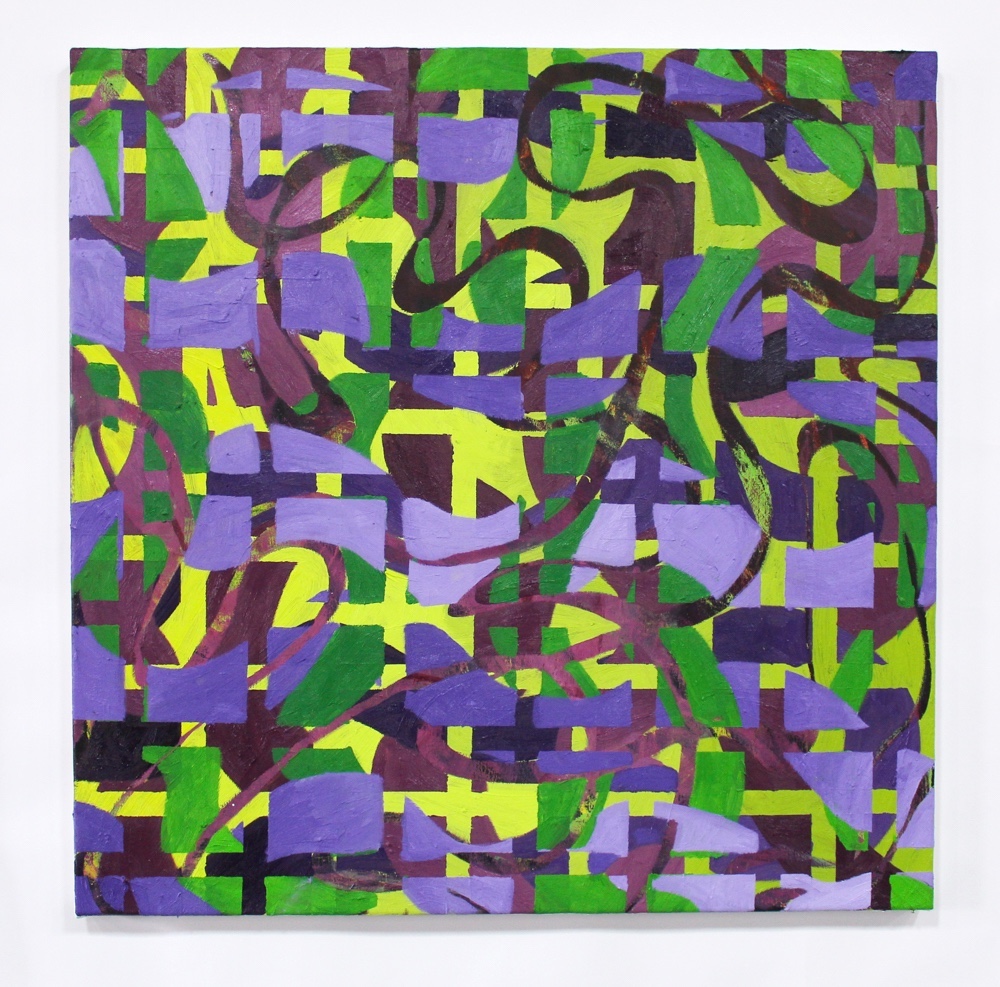
“My work is rooted within ecology and presents itself as abstract spaces of color, layered marks, soft patterns, and material depth. I am often searching for way to show life at the infinity level, with images that can read as micro or cellular points of view as well as macro perspectives of mapped out land or road systems. I like the tangle- it toys with grief inside the confusion of history and relationship to nature, as well as the celebration of material and color that paint has to offer.”
–Stephanie Manzi
Stephanie Manzi is a painter and educator from Upstate, NY, based in Philadelphia, PA. Her work studies ecology through color, pattern and material. She received her MFA at Tyler School of Art in 2022 and her BFA from SUNY Purchase in 2014. Her work has been shown on both coasts, including Big Ramp Gallery, Ice Box Projects and Pilot Projects in Philadelphia, PA, as well as Las Laguna Gallery, Covet Gallery, and Shoebox Projects in Southern California. Manzi received the Award of Excellence at Conception Arts NYC, Faculty Committee Life Grant from PCA&D and had work featured in Tinge Magazine and Friend of the Artist. She was a resident at Grand Marais Art Colony, Mount Gretna School of Art and ChaNorth Artist Residency and is an upcoming resident at DaVinci Art Alliance for 2025. Manzi most recently had work on display at Valdosta State University, a solo show at The Southern Vermont Art
════════════════════════════════════
Ben Pranger – Recursive Terrain
Tile Gallery
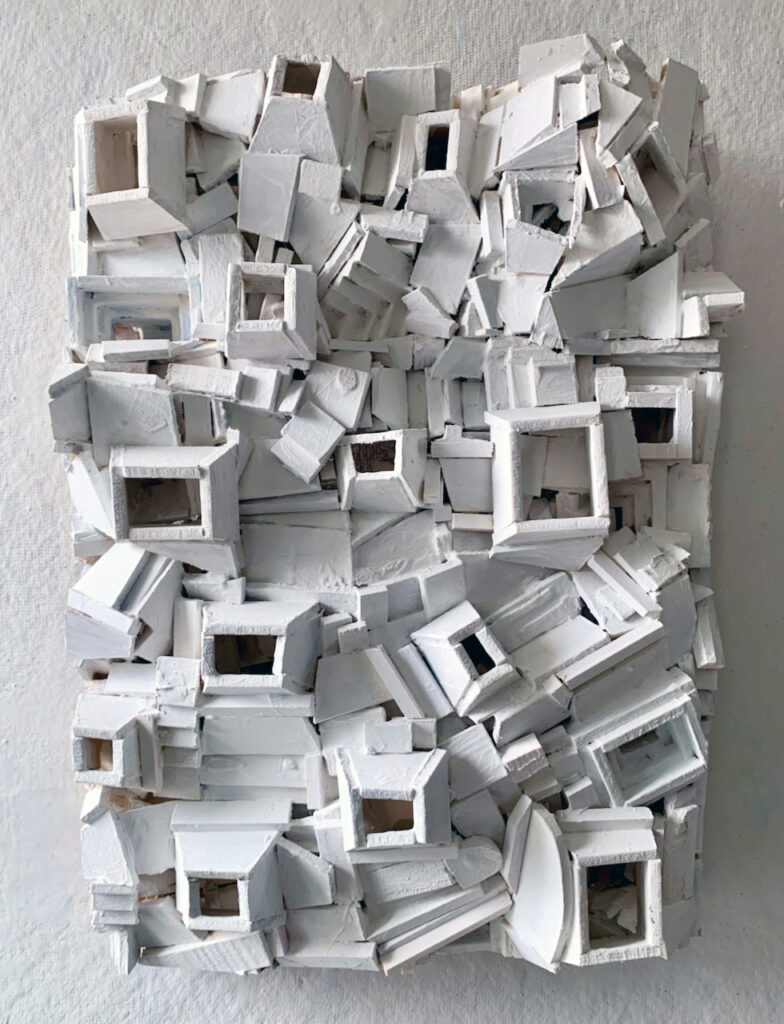
“My wall-based constructions slowly grow into emergent forms. Small pieces of wood are stacked and glued, drifting off course to traverse the space in front of the wall. The work follows simple rules that unfold organically to create entangled, rhizomatic structures. Many of the constructions suggest futuristic cities rising out of the rubble of their own destruction. Fragments from previous work coalesce into stairways, passages, apertures, enclosures and pyramids, leading the viewer through labyrinthine architectures. These indwellings map a recursive mental space that morphs into evolving worlds.”
– Ben Pranger
Ben Pranger has shown his work throughout the U.S., including recent group shows at Gallery Petite (NY), Curious Matter (NJ), Art House Gallery (NJ), Drawing Rooms (NJ), Artist-Run/ Satellite Show (Miami), Trestle Gallery (NY) and Grizzly Grizzly (PA). He has participated in artist residencies at Kohler Art/Industry, Fine Arts Work Center of Provincetown, the Marie Walsh Sharpe Studio Program, and the Virginia Center for the Creative Arts, and has received sculpture grants from the Virginia Commission for the Arts, the Virginia Museum of Fine Arts, the Pollock-Krasner Foundation and the New Jersey Council for Art.
════════════════════════════════════
For inquiries about work in our exhibitions, please contact our Gallery Manager at acook@abingtonartcenter.org.
2026 Annual Juried Show: Black & White
For any inquiries about work on display, please contact Gallery Manager, Amy Cook, at acook@abingtonartcenter.org.
2025 Summer Juried Show: The Real
Solo Series Fall 2025

Nothing is as it was, 2025 | Barbara Brady | Oil on canvas
On View Sept. 12 – Oct. 20, 2025
Opening Reception | Friday, Sept. 12 | 6:00p.m. – 8:00 p.m.
Artist Talk | Wednesday, Oct. 15 | 6:00 p.m. – 8:00p.m.
Featured Artists: Barbara Brady, Mike John Murray, Teresa Shields, Lisa Kelley
ARTISTS
Barbara Brady – Marking Time
Tile Gallery
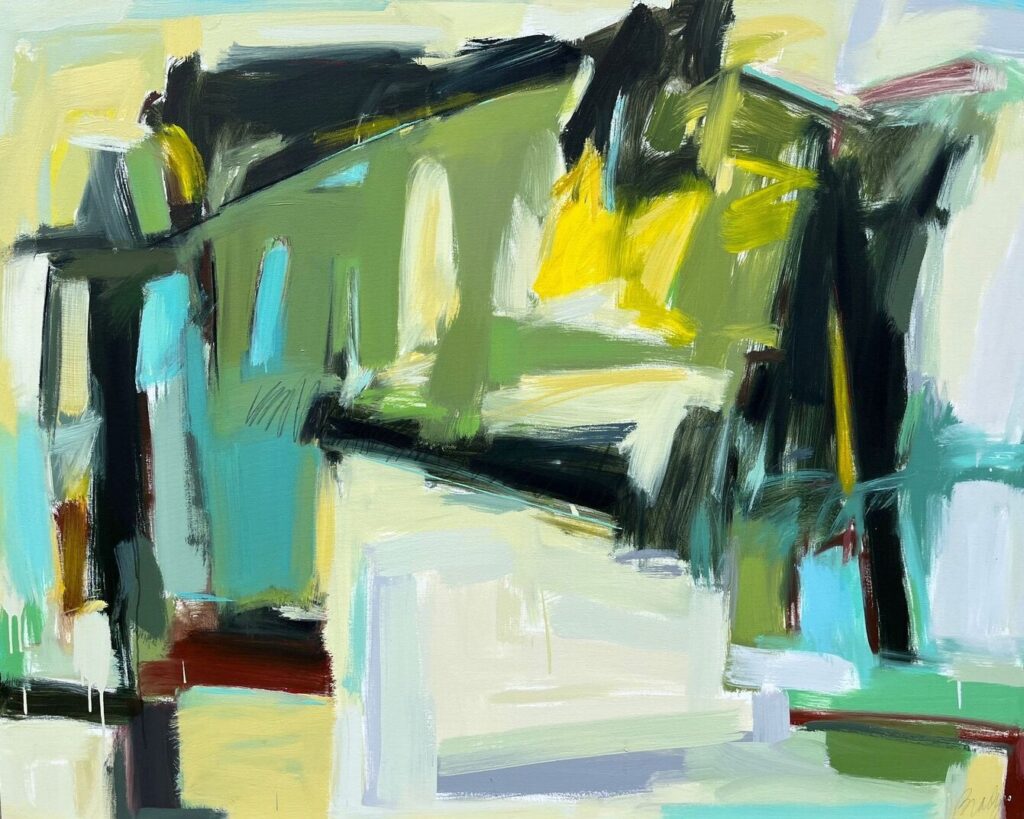
Barbara Brady creates expressionist paintings, drawing inspiration from her environment, world events, and personal experiences. Through expressive brushwork and bold color, Brady not only creates little worlds within larger spaces, but also captures glimpses of inexplicable moments within her work. Her paintings act as a visceral response to life and the world.
Brady lives and works on the coast of Maine. She received her BFA from Rosemont College and completed her post-graduate study at the Pennsylvania Academy of Fine Arts in Philadelphia, PA. After a 30 year career working as an art director and graphic designer for publishing and healthcare organizations on both coasts, it wasn’t until moving to coastal Maine in 2001 that painting became her passion. Her work has been exhibited in solo and group exhibitions within galleries, museums and cultural centers, and her work is held in corporate and private collections internationally.
Barbara Brady’s Marking Time is on view in our Tile Gallery.
Mike John Murray – Happily Imperfect Together
Book Room Gallery
Interdisciplinary artist, Mike John Murray, crafts objects that are intricate, unusual, yet whimsical. This is evident in how he plays with materiality and form, combining rough and smooth textures, stark colors, and recognizable and unrecognizable motifs. Murray’s work feels unreal and almost dream-like in how they are structured, leaving the viewer yearning for context. He acknowledges this ambiguity, noting “[my work] lingers at the edge of a more primal experience, quietly resisting the impulse to explain themselves.”
Mike John Murray was born in Vermont, and exposed to the Hudson River School of painters early in his youth, sparking interest in art. Murray received his formal arts education at a small university in rural Pennsylvania, and spent his time post-school traveling and learning from artists and craftspeople from across the Americas and Europe, influencing his studio work.
Mike John Murray’s Happily Imperfect Together is on display in our Book Room Gallery.
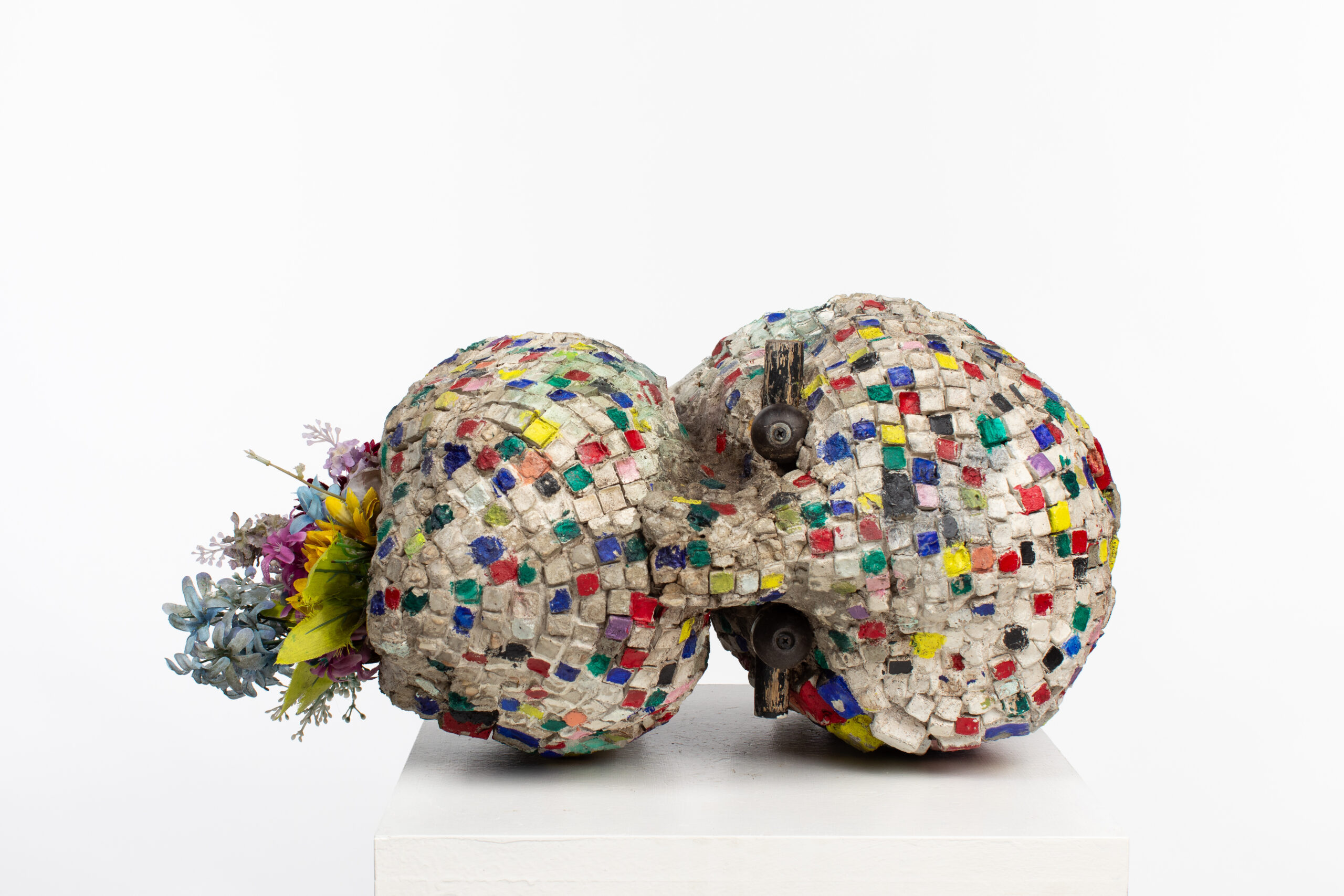
Teresa Shields, I Feel Seen
Kellner Gallery
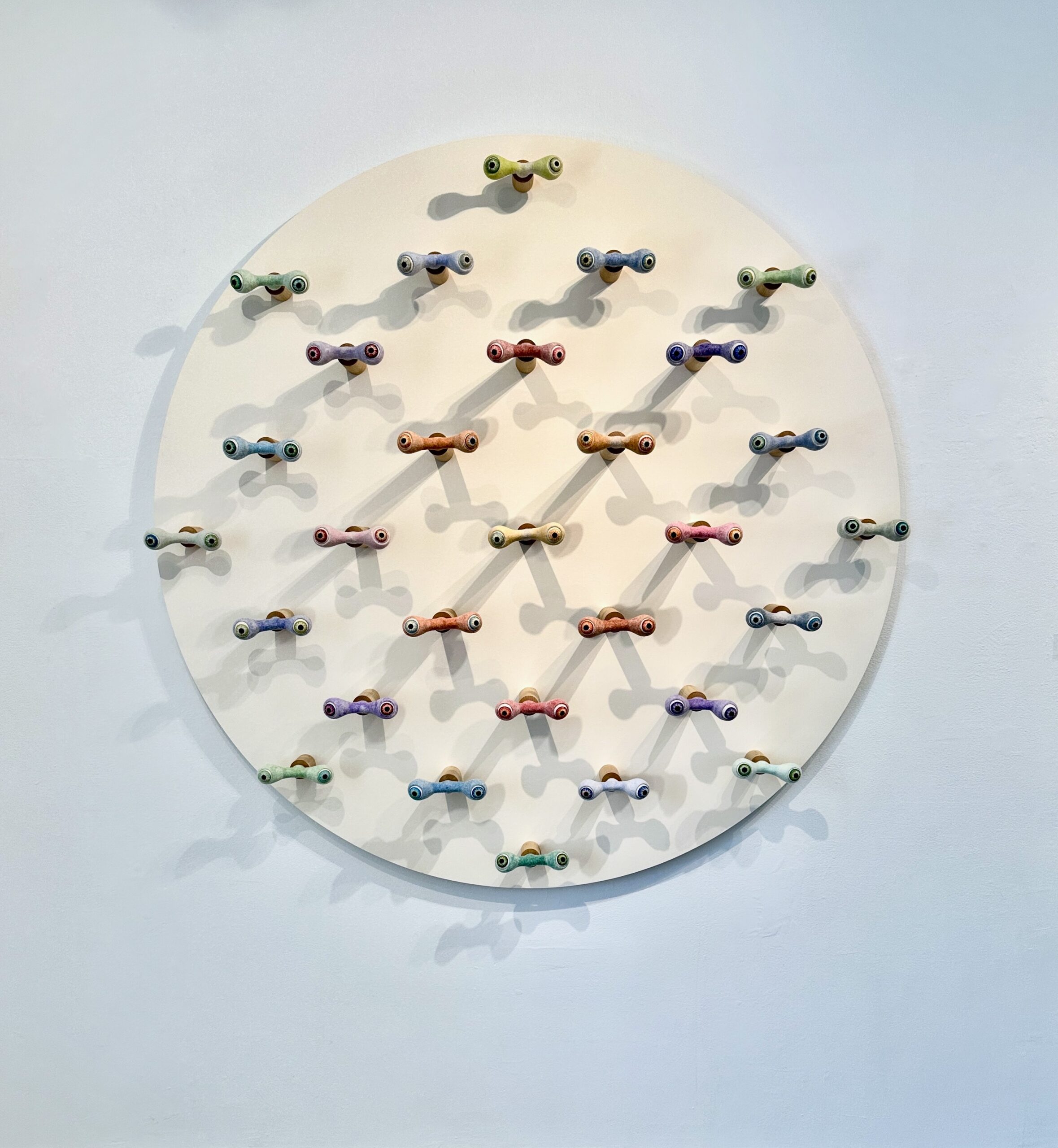
Teresa Shields weaves her fascination with fabric, thread, and wool fiber into a unique and colorful artistic journey. Her work invites viewers into the intricate world of embroidery and wet-felting, where she skillfully interprets abstract shapes and unravels new dimensions in materiality. Drawing inspiration from nature’s intricate designs–plant forms, human eyes, and cell structure–and the female gaze, Shields’s exhibition presents her unique perspective on women’s experience. Her sculptural eyeballs follow and see the audience in a way that allows them to be observed while actively returning attention. The sculptural necklaces connect her process to the earliest adornment of human bodies and the manner in which women use external objects of beauty to create meaning.
Teresa Shields is an artist based in Jenkintown, PA. She earned her BFA from Carnegie Mellon University and her MFA from Mass College of Art. Known for her idiosyncratic work that beckons tactile engagement, Shields has exhibited across the country, accumulating over 20 awards and collections by eight institutions.
Teresa Shields’s I Feel Seen is being exhibited in our Kellner Gallery.
Lisa Kelley, Respite
Community Arts Gallery
Lisa Kelley is a trauma-certified artist and advocate who is committed to building community through art-making. Inspired by the urban landscape she grew up in, as well as the fields and forests she takes respite in, Kelley sees the beauty “in decay, in rusted steel, in golden fields, in wings in flight, in the squeal of sirens, the rumble of the el, the rustle of the trees, the song of the birds.” Her artwork serves as a call to action, helping bring awareness to those struggling with addiction and giving them a voice through collaborative artwork.
Lisa Kelley earned her BFA from Moore College of Art and Design and is a teaching artist at Prevention Point and Philly Home, organizations that serve people with substance use disorder and homelessness in the Kensington and Fairmount neighborhoods of Philadelphia.
Kelley recently completed her 2 year artist residency at Abington Art Center’s Little Meetinghouse. Throughout her residency, she not only hosted free, monthly community art-making events, but also created a new body of work informed by the connections she has made as an artist in residence and continued connections with those in Kensington.
Lisa Kelley’s Respite is on view in our Community Arts Gallery.

For inquiries about work in our exhibition, please contact our Gallery Manager at acook@abingtonartcenter.org.
Solo Series Spring 2025
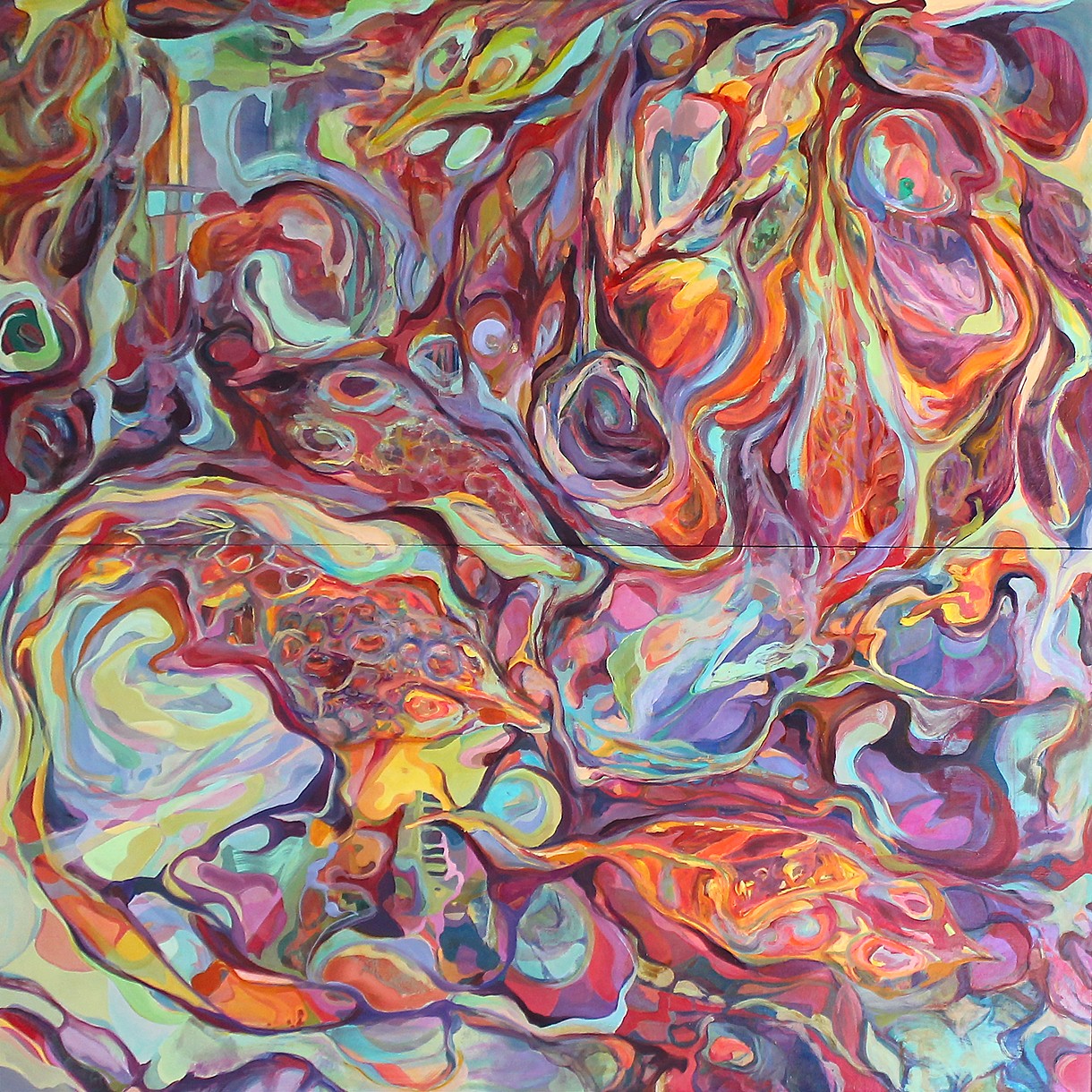
Primordial Soup, 2022 | Kristen Letts Kovak | Oil and acrylic on wood panels, $6,000
On View May 2 – June 9, 2025
Opening Reception | Friday, May 2 | 6:00p.m. – 8:00 p.m.
Artist Talk | Saturday, May 17 | 10:00 a.m. – 12:00 p.m.
Artist Talk | Wednesday, May 28 | 6:00 p.m. – 8:00p.m.
Featured Artists: Cecelia Grant, Kristen Letts Kovak, Mari Elaine Lamp, Athena Tasiopoulos
ARTISTS
Cecelia Grant, Mixed Media
Tile Gallery
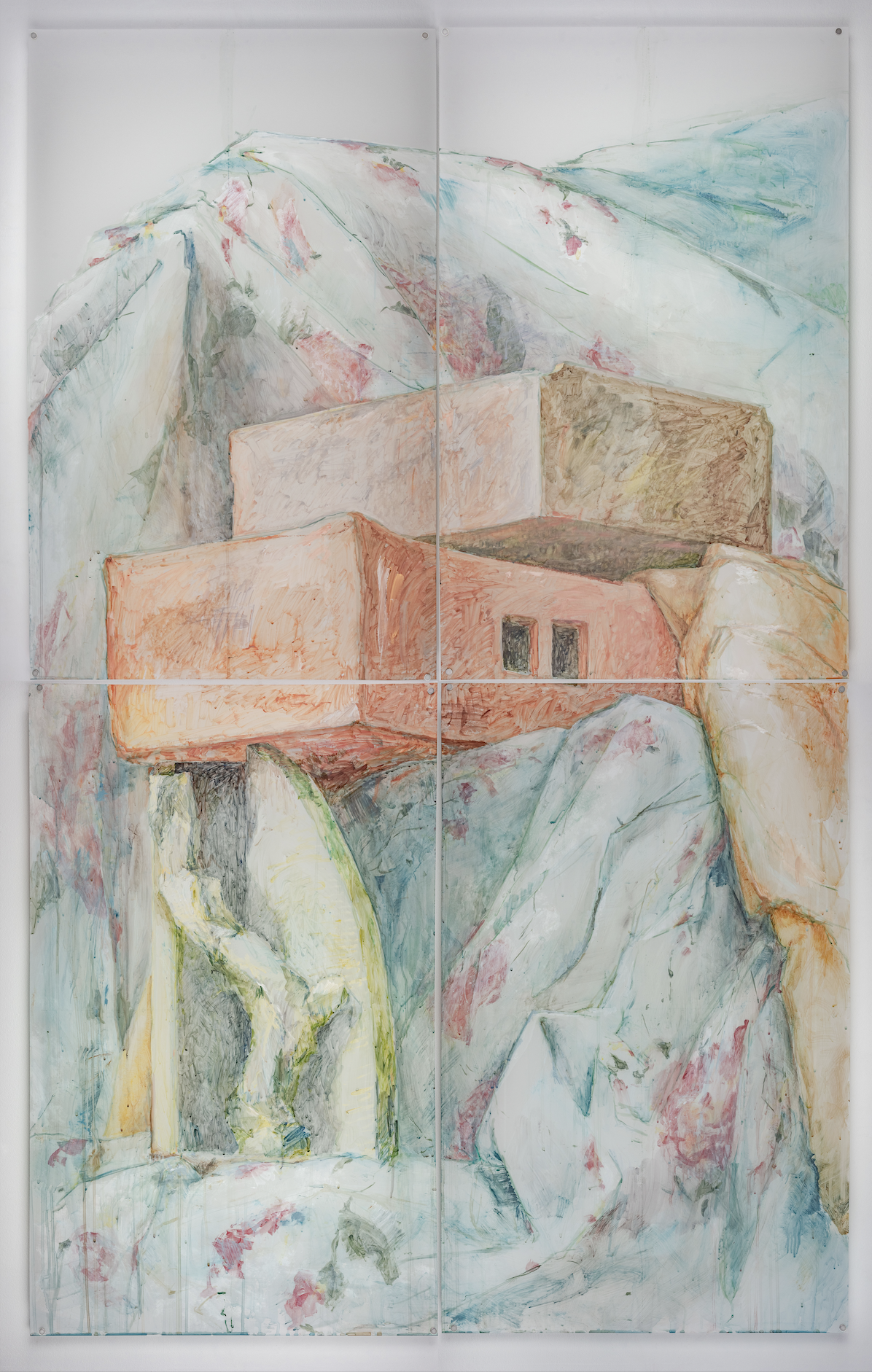
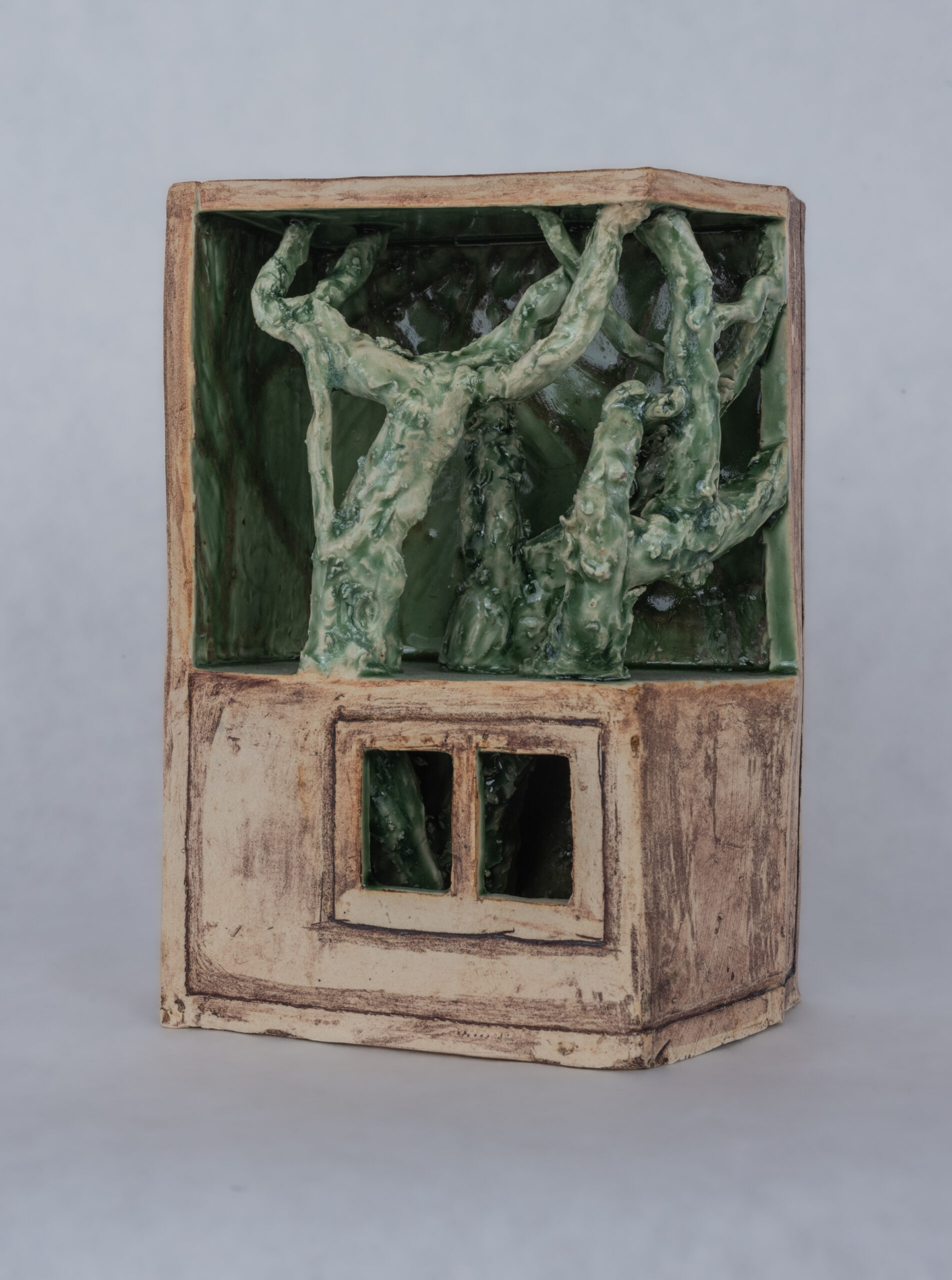
Cecelia Grant is an interdisciplinary artist working in printmaking, sculpture, and painting. Her work is self-referential, utilizing instances and subjects from previous paintings that then become molded in ceramic and used as objects in her still life sets. The result of which is a group of automorphic works not siloed in ideas of still life, architecture, nor nature.
Grant creates her paintings on atypical surfaces, typically cardboard or translucent polyester film, also known as mylar. She developed a unique method of installing her translucent mylar paintings with air between the mylar surface and the wall, allowing for light to project from the wall through the translucent surface and giving the work the illusion of floating. When using cardboard as a surface, she labels the media in detail, allowing audiences to create associations between consumption of food and art materials, and creation.
Cecelia Grant’s work has been included in the nationally juried exhibition Crosscurrents at the Pennsylvania Academy of the Fine Arts’ Annenberg Gallery in 2019. She has also shown work in both juried and group shows in Pennsylvania, Maryland, and Italy, and solo shows in Kutztown and Ambler, PA. Grant was awarded the Board of Governor’s Scholarship to study painting at Kutztown University and earned her BFA in May of 2020. In her time as a student, she trained for a semester in Rome at Tyler School of Art. She currently serves as a faculty member at Gwynedd Mercy Academy High School and upholds her studio practice through visits to galleries and museums.
Cecelia Grant’s Leveled Ground, Unleveled Ground is on view in our Tile gallery.
Kristen Letts Kovak, Painting
Kellner Gallery
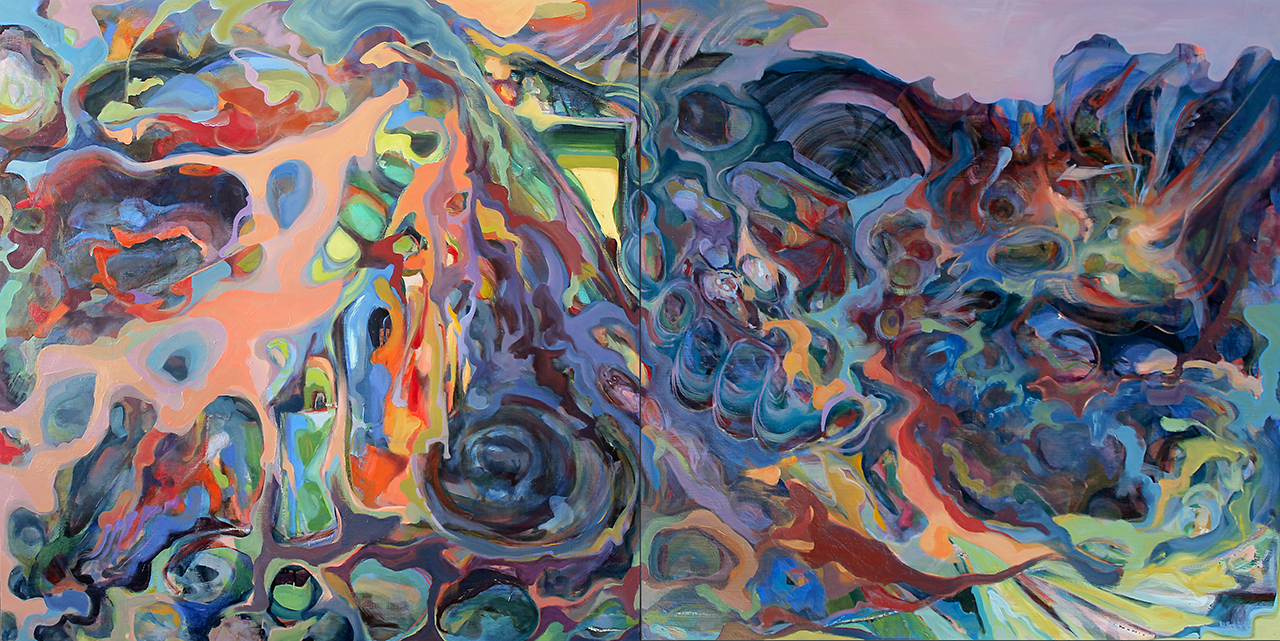
Kristen Letts Kovak is an artist, professor, and curator based in Pittsburgh, PA. She resists clarity within her work, shifting images into states of disarrangement that explore the uncertainties of living with chronic illness. Her drawings and paintings are evident of this; they balance opposing forces to arrive at harmonious states of disequilibrium.
Out of Order, on view in our Kellner gallery, is a visual reflection on living with chronic illness and disability, where even the present is wrapped in uncertainty. Each painting, like each day, begins as an unsettled conjecture. While largely abstract, Kovak’s artworks begin with a threadbare link to representation in both form and technique. She then deliberately resists clarity and shifts the images into states of disarrangement and imbalance. The finished pieces are records of her visceral decisions and the accumulation of renegotiated visual pathways. She invites the viewer to join her on unexpected detours, “where a wrong turn can be embraced, rather than avoided.”
Kristen Letts Kovak earned her BFA from Mercyhurst University and her MFA from MICA. Since 2012, Kovak has taught drawing, painting, perception, and applied aesthetics at Carnegie Mellon University, where she also serves as Senior Associate Dean of the College of Fine Arts.
Her works have been exhibited widely with solo exhibitions at colleges and universities, and her paintings and drawings have been featured in more than fifty group exhibitions, including the Center for Contemporary Art, Milwaukee Institute of Art and Design, Williamsburg Art and Historical Center, SPACE gallery, Pittsburgh Center for the Arts, Wildling Art Museum, Arizona-Sonora Desert Museum, IUPUI, Muskegon Museum of Art, Erie Art Museum, Museum of the Red River, Woodson Art Museum, and the State Museum of Pennsylvania.
Mari Elaine Lamp, Painting and Installation
Book Room Gallery
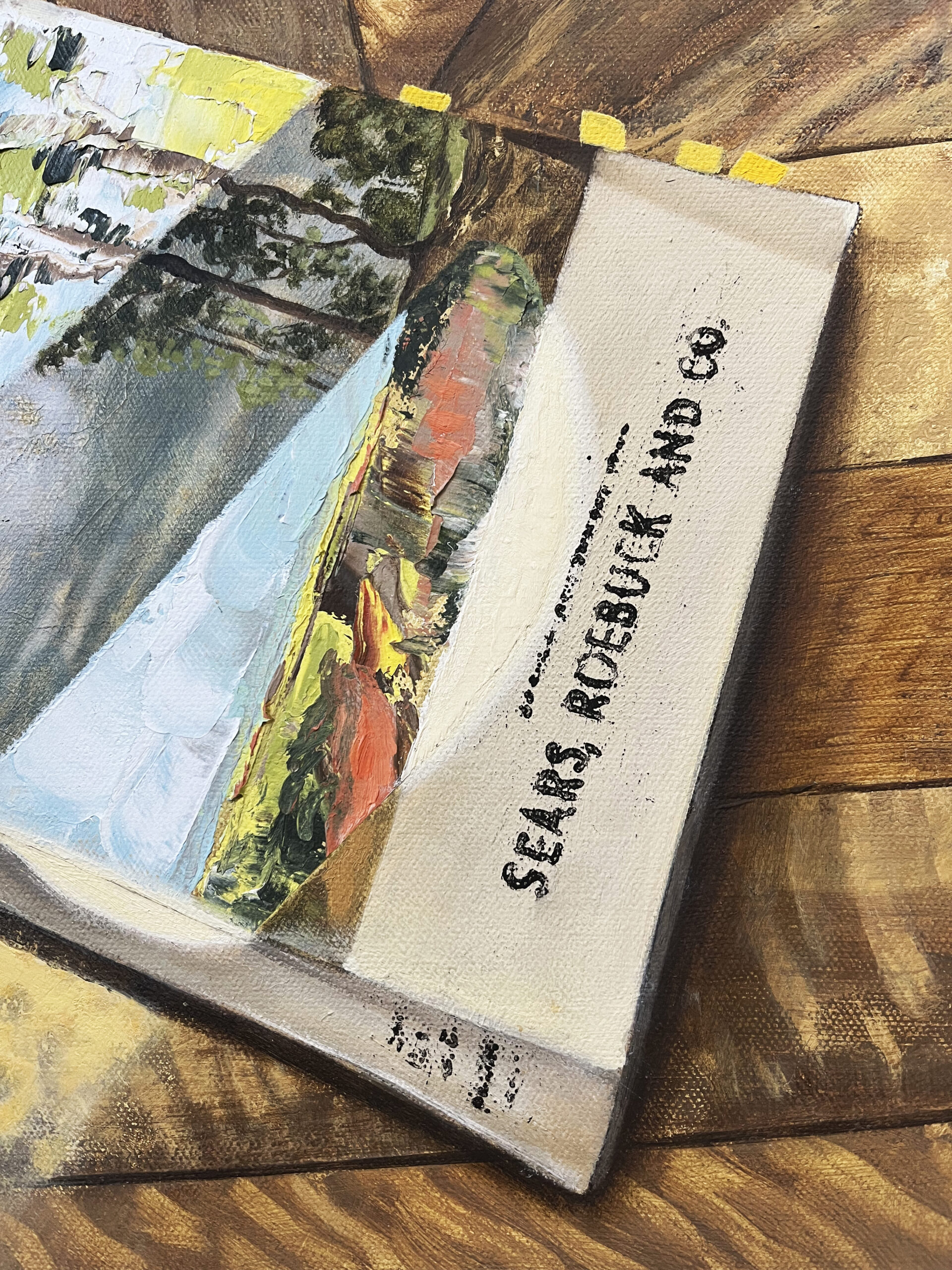
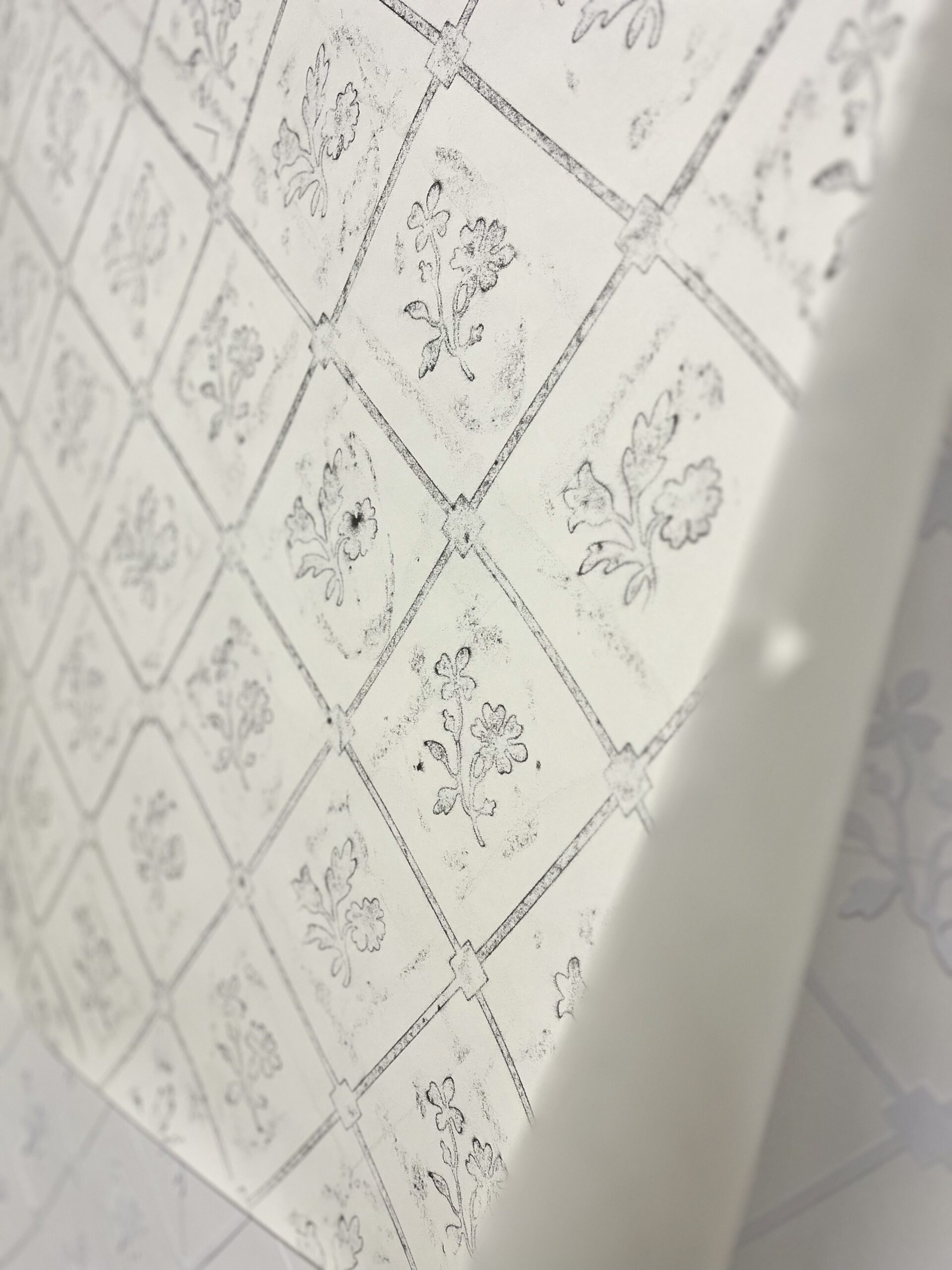
Mari Elaine Lamp is an artist living and working in Philadelphia, PA. Her training in representation has led her beyond the figure as an end in itself and into an investigation of the spaces that the figure inhabits, both psychologically and physically.
Wish Book, on view in our Book Room gallery, is a site-specific installation that dives deep into Abington Art Center’s rich history as a former private manor and its ties to Sears and Roebuck company through the building’s original owner Lessing Rosenwald, heir to the Sears fortune. Interested in how one gets their ‘stuff’, the everyday objects one dreams about, acquires, and uses, Lamp explores material objects and their ties to history and the consumer. Her frottage installation hung in our Book Room gallery takes direct inspiration from the wallpapers, fireplaces, and artwork that was available for purchase in the Sears and Roebuck catalogs of the early 20th century. Her paintings reference a portion of the vast selection of objects available particularly in the early decades of the catalog, from tools and clothing to guns and bibles. She notes, “while what we dream about may have changed, [the] desire itself is always present, an interior catalog of wishes fulfilled and unfulfilled.”
Mari Elaine Lamp received her MFA from the Pennsylvania Academy of the Fine Arts in 2017 and studied at The School of Representational Art in Chicago, IL. In 2021, Lamp presented a solo show at Brookdale Community College in Lincroft, NJ, featuring her domestic interior paintings. She has also shown at Gross McCleaf Gallery, the Woodmere Art Museum, and Fjord Gallery in Philadelphia, On Stellar Rays in New York, the Workhouse Art Center in Lorton, Virginia, and the Katzen Art Center at American University in Washington DC.
Athena Petra Tasiopoulos, Encaustic
Community Arts Gallery
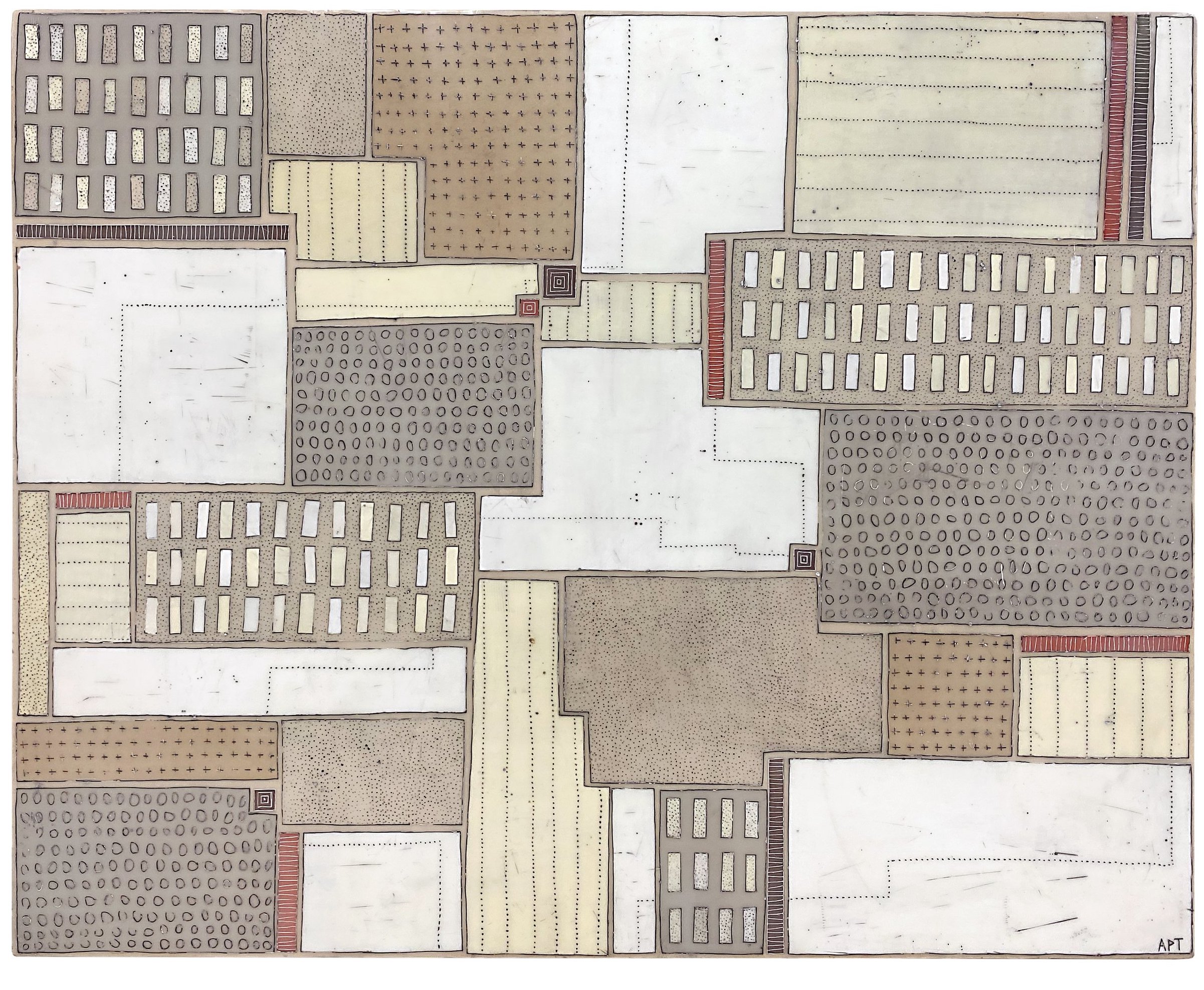
Athena Petra Tasiopoulos is a mixed media collage artist, who explores mental and emotional blueprints, the push and pull of interconnectedness, and the delicate nature of equilibrium through her encaustic works.
Tasiopoulos works with recycled and found vintage papers, encasing them beneath a layer of encaustic, also known as beeswax. Her artistic practice acts as a form of meditation on transience, transformation, and the beauty of imperfection, gravitating toward soft and muted color tones. The repetitive patterns and primitive marks she carves and scrapes into the surface of the wax speak to the imperfections of the human hand and the vulnerability of materiality.
Athena Petra Tasiopoulos is originally from Pennsylvania, but currently resides in central Vermont. She is represented by Soapbox Arts gallery in Burlington, VT, and her work is collected internationally. Her work has been featured in publications such as ELLE Magazine (USA and Japan), Frankie Magazine (Australia), and Collage by Women: 50 Essential Contemporary Artists by Rebeka Elizegi (published by Promopress, Spain).
Athena Petra Tasiopoulos’ Inner Spaces is on display in our Community Arts gallery.
For inquiries about work in our exhibition, please contact acook@abingtonartcenter.org.
Primordial Soup
American Color Print Society Members Spring Exhibition

On View March 17 – April 21, 2025
Opening Reception | Saturday, March 15 | 2:00p.m. – 4:00 p.m.
American Color Print Society Members Spring Exhibition
In the year 1939, the founding members of the American Color Print Society decided to create an organization for the exhibition of color prints. This was a time when only black and white prints were considered worthy of display in museums and galleries. The three founding members were Florence V. Cannon, Mary Mullineaux and Waunita Smith.
The American Color Print Exhibition of 1940, which included the work of the 85 original members, heralded the arrival of the color print as an American print medium. The use of color in printmaking encouraged artists to experiment with the traditional methods of printmaking such as lithography, block printing, etching, intaglio and monotype. This led to other printmaking techniques including the use of collage, found materials and digital printmaking.
There have been many distinguished members during the eighty-plus year history of the organization. Among them have been Benton Spruance, Jerome Kaplan, Stella Drabkin, Jacob Landau, Dorothy Hutton, June Wayne, Eugene Feldman, Ethel Ashton, Bernard Kohn, Jeanette Kohn, Mildred Dillon, Abraham Hankins, John Taylor Arms, Richard Hood, Francoise Gilot, Samuel Maitin, Elizabeth MacDOnald, Jack Gerber, Thelma Grobes, Idaherma Williams, and Merle Spandorfer.
Today, the American Color Print Society is a national non-profit corporation with the following purpose:
“To promote and foster original graphic art: to encourage and promote exhibitions of original color prints and to educate art students and the public about the varied techniques of original color printmaking.”
Venues of recent exhibitions have included Villanova University (Connelly Center), the Print and Picture Collection of the Free Library of Philadelphia, Cheltenham Center for the Arts, Abington Art Center, The Plastic Club, the Chestnut Hill Gallery, Philagrafika International Print Festival, and the Mark Arts Center (Wichita, KS).
For more than 80 plus years, the ACPS membership has not only been inventive with their technical skills, but has grown geographically as well. In addition to Pennsylvania, members represented in our exhibitions are from New Jersey, New York, Illinois, Indiana, Louisiana, Mississippi, California, Tennessee, Texas, North Carolina, Rhode Island, Michigan, and New Mexico.
Juror

Lisa Kelley is a teaching artist
at Kensington Storefront and Prevention Point, organizations that serve people struggling with addiction and homelessness in the Kensington neighborhood of Philadelphia. She earned her BFA from Moore College of Art and Design and is a trauma-certified artist and advocate, committed to building community through art-making.
Award Winners
Best in Show
How Many Years Since My Birth
Bates Mandel, Screenprint (20 layers), Archival Digital Print, $400.


Second Prize
A Past Forgotten
Herbert Appelson, Hand-threaded Embossment, $2,000.
Third Prize
Planets of the Universe
Robert Reinhardt, Monoprint Collage, $300.

Honorable Mentions
Bonnie Goldstein, Gliding, Woodblock Print, $2000.
Valerie Dillon, Woven Ladder, Collagraph, Linocut, and Embroidery, $250.
Margo Tassi, Snow, Beaver River, Etching $600.
Exhibiting Artists
Bobbie Adams
Marlene Adler
Nancy Alter
Herbert Appelson
Rhonda Babb
Janet Badger
Jessica Barber
Alyse C. Bernstein
Doug Billings
Art Brener
Bill Brookover
Elaine Buono
Maryann Cannon
Kathleen Chapman
Ron Chereskin
Valerie Dillon
Donna Douglass
Susan Dubrunfaut
John Formicola
Bonnie Goldstein
Susan Hoffmann
Robert Hunter
Georgina Johnson
Theresa Kehrer
Julie Kring
Neila Kun
Michael Lasuchin
Steve Kennedy
Hee Sook Kim
Alan Klawans
Victor Lasuchin
Patricia Shaw Lima
Michael Long
Bates Mandel
Martha Martin
Carole Meyers
Miki Nagano
J.A. Panetta
Robert Reinhardt
Virginia Rosa
Darrell Smith
Patty Smith
Charles Spitzack
Elizabeth Stricker
Margo Tassi
Ani Vassileva
Select Works
Solo Series Winter 2026
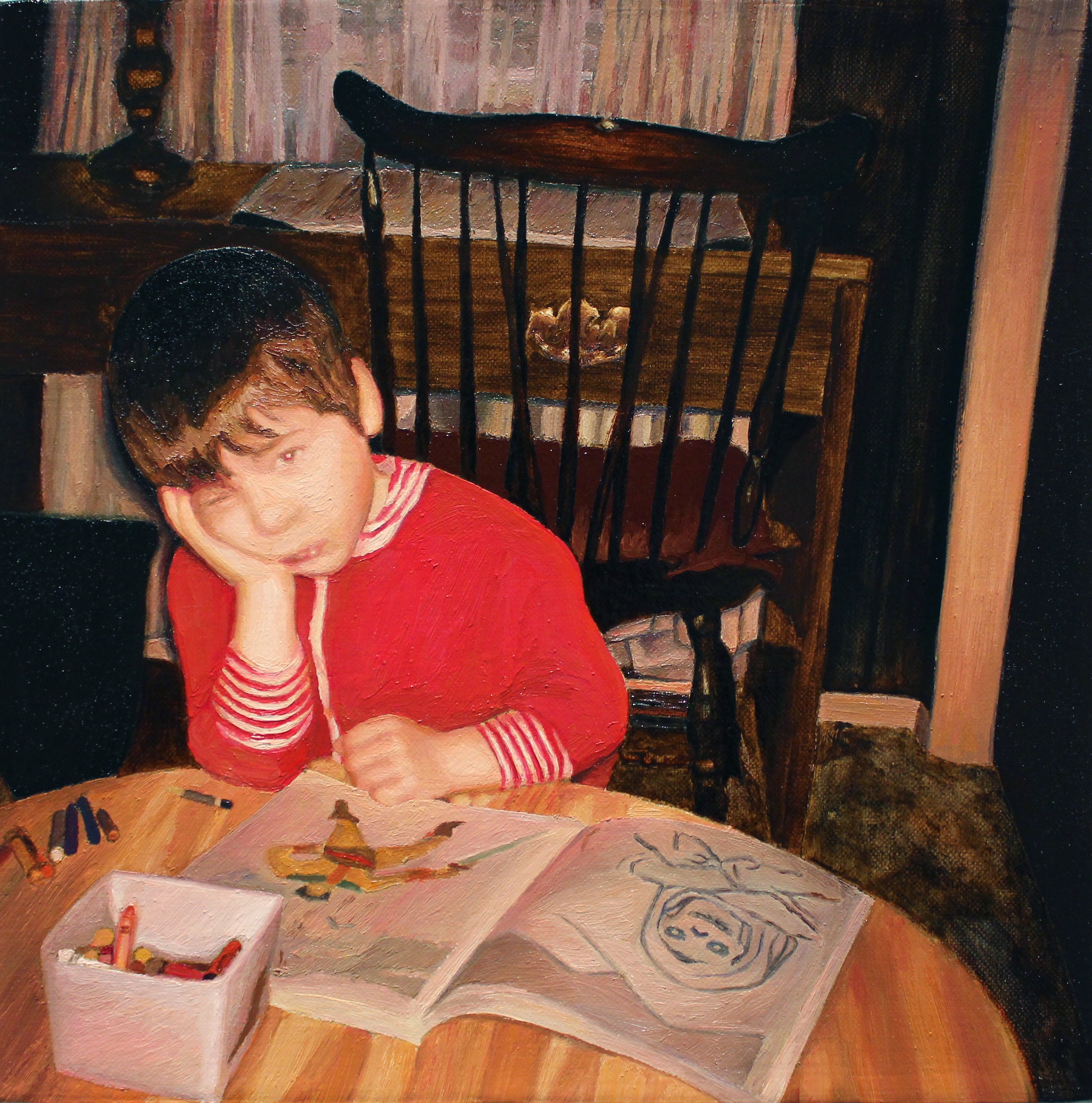
Coloring Book, 2023 | Ezra Thompson | Oil on linen
On View Jan. 16 – Feb. 23, 2026
Opening Reception | Friday, Jan. 16 | 6:00p.m. – 8:00 p.m.
Artist Talk | Michelle Marcuse | Wednesday, Feb. 4 | 6:00 p.m. – 8:00p.m.
Featured Artists: Michelle Marcuse, Ezra Thompson, and Karen Cooper
ARTISTS
Michelle Marcuse – Fray
Kellner Gallery

“Emerging from the slopes of Table Mountain in Cape Town, where apartheid’s shadow cut through my childhood innocence, I learned early that beauty and brokenness are not opposing forces, but interconnected narratives that I can reimagine. Alongside my brother, we constructed elaborate tales of make-believe worlds from the overgrown African outdoors. This became my first topography of repair as we collectively pieced together our imaginary environments, unconsciously practicing rebuilding a fractured world. My childhood seemed idyllic, but the ever-present specter of South Africa’s politics loomed in the background. Since then, I have continued to wrestle with the potential for harmony and discord to co-exist simultaneously.
My practice has become an extension of these early impulses: to create environments, transform brokenness and reimagine possibility. Characterized by fragmented compositions, my work is defined by the presence of my hands as both a destructive and constructive force. Working in abstraction, I blend real perspective with areas of flat pattern, forming hybrid, textured landscapes. Creating form is like solving a puzzle; each piece evolves through experimentation and discovery. Process is central to my practice, and I prefer to innovate over technical proficiency. Guided by a deliberate yet restless inquiry, I explore the tension between rhythmic delineation and negative space. Materials — wire, raffia, string, and found cardboard— are chosen for structural malleability. These everyday items reflect the contradictions feeding my work, oscillating between states of value and insignificance. Moving from earth to factory, they become commercial waste that I translate into abstract form. Whether large and free-standing or small and wall-mounted, the act of constructing material leaves behind messy remnants—visible layers of texture that keep my work in flux. In a world increasingly drawn to perfection, these are important to me as I seek evidence of human touch and its inherent vulnerability.
Through aleatory connections and pattern recognition, I trace the hidden architectures of chaos, making visible the intricate markings that connect and transform—leaning into complexity, and holding its contradictions alongside its aspirations, reassembling both materials and hope itself.”
— Michelle Marcuse
Michelle Marcuse is a South African-American artist whose work explores the contradictions that shape our perception of reality, often influenced by the lens of cultural heritage. Born in 1957 in South Africa, she immigrated to the United States in 1984, establishing herself in Philadelphia where she maintains an active studio in Fishtown. Marcuse holds a Bachelor of Design from The Shenkar College of Engineering and Design in Israel and a BFA in painting from Tyler School of Art in Philadelphia.
Her work has been exhibited in solo and group shows at prestigious venues including the Corcoran School, BLAM Projects, Taller Boricua, Little Haitian Cultural Center, Art Life Foundation, and Restart Museum in China. In 2024, Marcuse became a resident artist at the Brandywine Print Workshop, where she collaborated with Master printmaker Alexis Nutini. That same year, she participated in (re)FOCUS/2024, a significant citywide exhibition celebrating the 50th anniversary of Philadelphia Focuses on Women in the Visual Arts. Marcuse is also a 2025 recipient of an Anonymous Was A Woman award—an unrestricted grant awarded annually to 15 woman-identifying artists over 40 at a critical junction in their career.
Notable earlier exhibitions include Cultivated Spaces at Rowan University (2022), which examined socio-economic, cultural, and environmental concerns in creative practices; Arte y el Amor at Taller Boricua, NYC (2016), where she exhibited alongside her partner in a show exploring how relationships sustain artistic practices; and Borderless Caribbean at the Haitian Cultural Arts Alliance in Miami (2015), which investigated the fluidity of thoughts, materiality, and cultural exchange.
A CFEVA Fellow alumni and Joan Mitchell Foundation shortlist honoree, Marcuse’s work resides in several collections, including The Philadelphia Art Museum. Her commitment to fostering an artistic community extends beyond her studio practice—she previously served as co-director of HouseGallery, a community-based art space in her residence in Fishtown. Marcuse is also a 2025 recipient of an Anonymous Was A Woman award—an unrestricted grant awarded annually to 15 woman-identifying artists over 40 at a critical junction in their career.
════════════════════════════════════
Ezra Thompson – The Kid Stays in the Picture
Tile Gallery
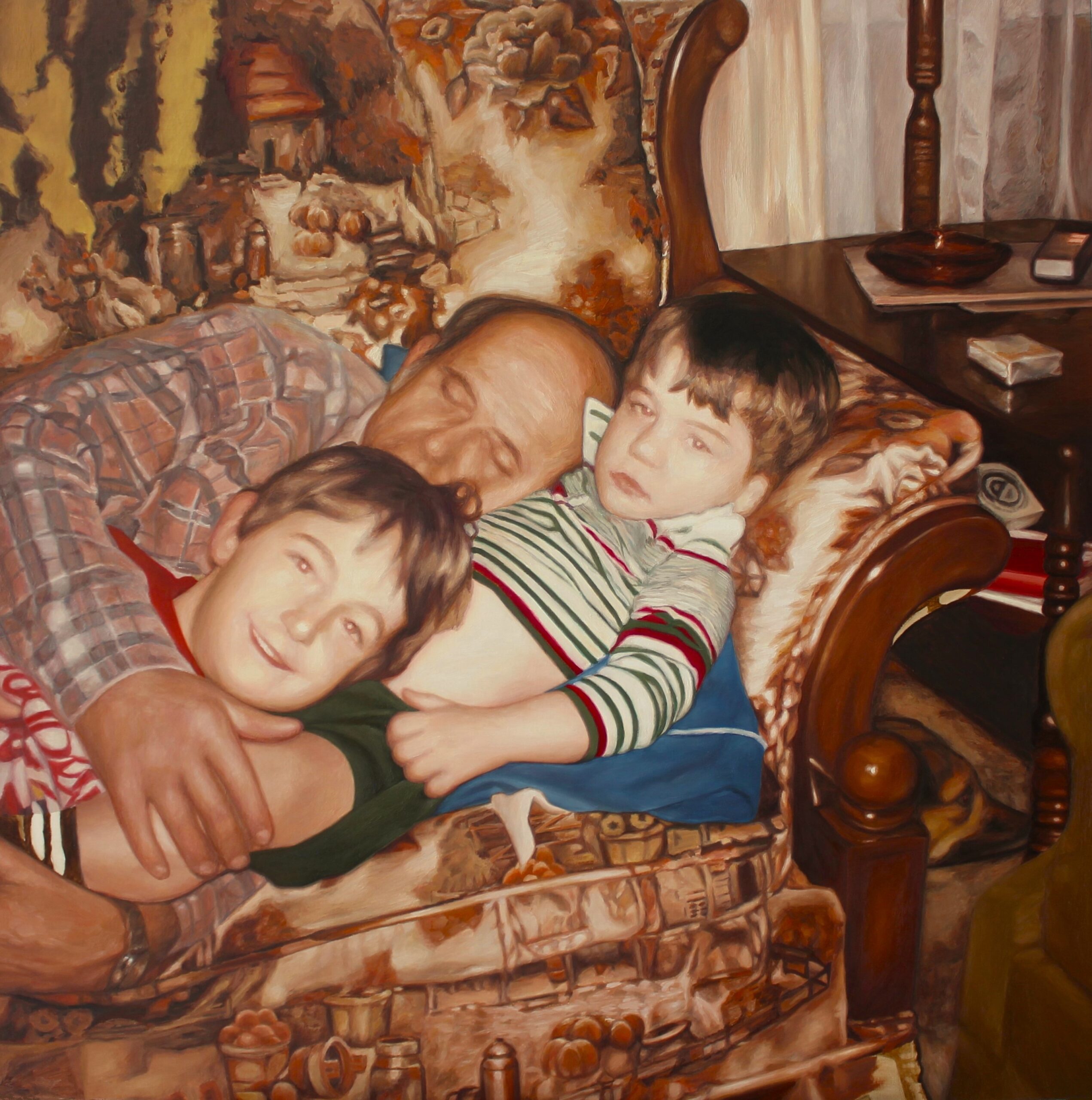
“My recent paintings have been concerned with the theatre of memory. In revisiting memory and the past through the photograph, I am attempting to re-learn the use of ‘signs’ to understand and communicate reality. Beginning with the snapshot, I select everyday experiences of life that appear to be instantly unfolding. The initial awkwardness of the subject is only secondary to my larger concern — the experience of loss and exclusion: loss of loved ones, loss of affection, friendship, and innocent joy. In creating this body of work, there is an attempt to recapture that loss and thus save it from destruction. It is only through this re-visitation of the photograph in adulthood that one hopes to ‘fill in’ or at least ‘pick up the pieces.’ The painting thus becomes a true remembrance of things past.”
— Ezra Thompson
Ezra Thompson is an artist whose work navigates abstraction, surrealism and realism, exploring the intricate forces that shape identity and the complexities of self-perception. Through his paintings, Thompson engages in a dialogue between the conscious and subconscious, the personal and the universal.
Ezra has attended residencies at the Vermont Studio Center and Aljira Emerge in Newark, New Jersey. He was granted the American Scandinavian Foundation Fellowship and a Rothenberg Fellowship for projects in Copenhagen and Berlin, respectively. His work has been exhibited at the Parrish Art Museum, Heckscher Museum of Art, Ferrara Showman Gallery, Gallery 263, Greenwich Art Society and other venues in the Greater New York region. Most recently his work was selected for the White Columns Curated Artist Registry. He has also served as a Curatorial Intern at the Whitney Museum of American Art and held a position as a Conservation Assistant at the Frick Collection’s Art Reference Library in New York City.
Thompson received a BFA from The Cooper Union (NYC) and an MFA in Studio Art from Stony Brook University (NY), where he is currently a Lecturer in the Department of Art. He is based in Long Island, NY.
════════════════════════════════════
Karen Cooper – kozukuri – small works
Book Room Gallery
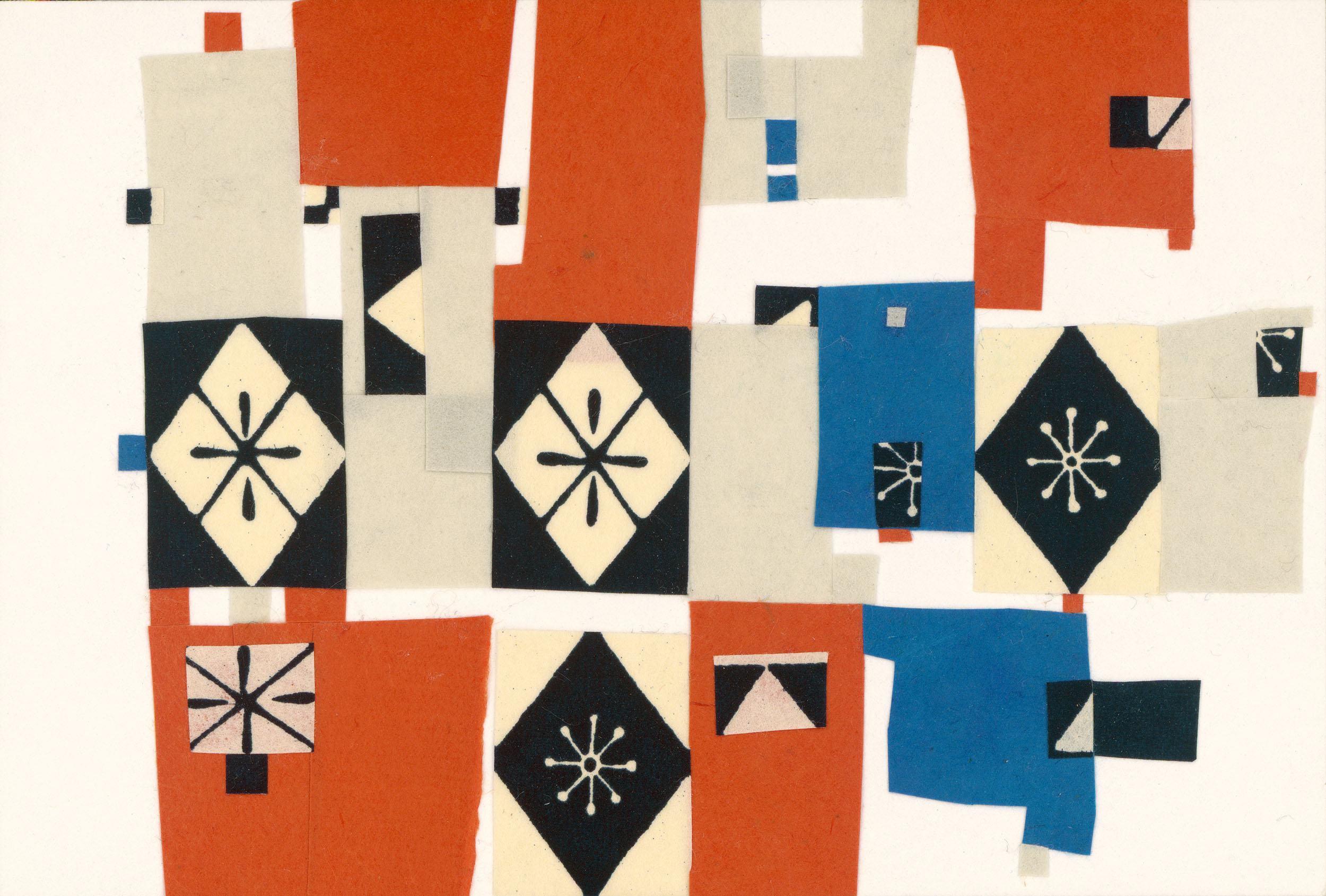
“My work is quiet. I take a meditative approach. My desk is cluttered with fractured pieces, but then I’ll take a piece and put it next to another and it begins to tell me something… to tell a story. When I add the next element the story may change. Sometimes, as I add to the story, finding the next element becomes more and more difficult. I’ll put the work aside for days, weeks or months. Then, suddenly, the solution will appear, like an insight that solves a mathematical puzzle. The work contains color and form, but also white space, which plays an equally powerful and important role. I recently started to add thread to collages as a connective tool; a way to help the eye move around the work in a balanced way.”
— Karen Cooper
Karen Cooper has a background in graphic design, having completed coursework through The School of Visual Arts and studying closely with graphic designers, Dale Moyer, Ed Benguiat, and Roger Ferriter. She built a business as a freelance mechanical artist, which involved the precision manual assembly of type and images before the advent of computer-based graphics, and worked for graphic design companies including: Bernhardt/Fudyma Graphic Design; Vignelli & Associates; Nautical Quarterly; Upper & Lower Case; Peckolick & Associates and Sothebys. Cooper then founded her own studio as a graphic designer, working primarily with corporate health care hospitals and service providers in the New York Metropolitan area.
Karen Cooper began to work with hand-dyed cloth, composing abstract pieces using quilting techniques, but it wasn’t until moving to Japan for two years that she grew an interest in handmade washi paper—an element that remains evident in her work. She experiments with small, abstract collages incorporating found paper, washi paper, thread, cloth, and other everyday materials.
════════════════════════════════════
For inquiries about work in our exhibitions, please contact our Gallery Manager at acook@abingtonartcenter.org.
Solo Series Winter 2025
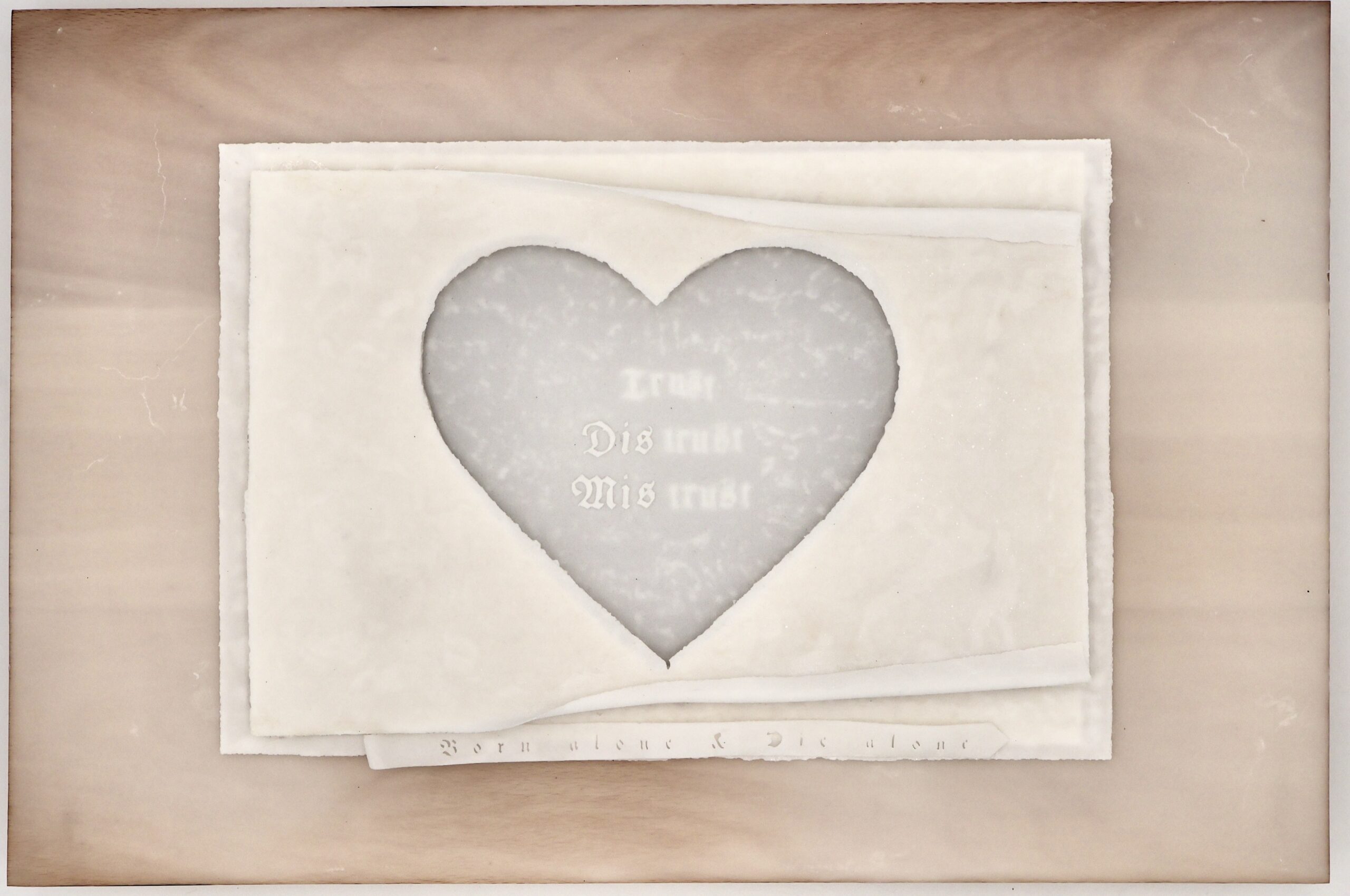
Fraktur “Trust”, 2024 | Kate Strachan | Ceramic, felt, wax & wood, $1,000
On View January 16 – February 24, 2025
Opening Reception | Thursday, January 16 | 6:00p.m. – 8:00 p.m.
Artist Talk | Saturday, February 1 | 10:00 a.m. – 12:00 p.m.
Artist Talk | Wednesday, February 12 | 6:00 p.m. – 8:00p.m.
Featured Artists: Eric Anthony Berdis, Alicia Finger, Jenna Hannum & Kate Strachan
DIGITAL CATALOG
ARTISTS
Eric Anthony Berdis, Fiber and Installation
Community Arts Gallery
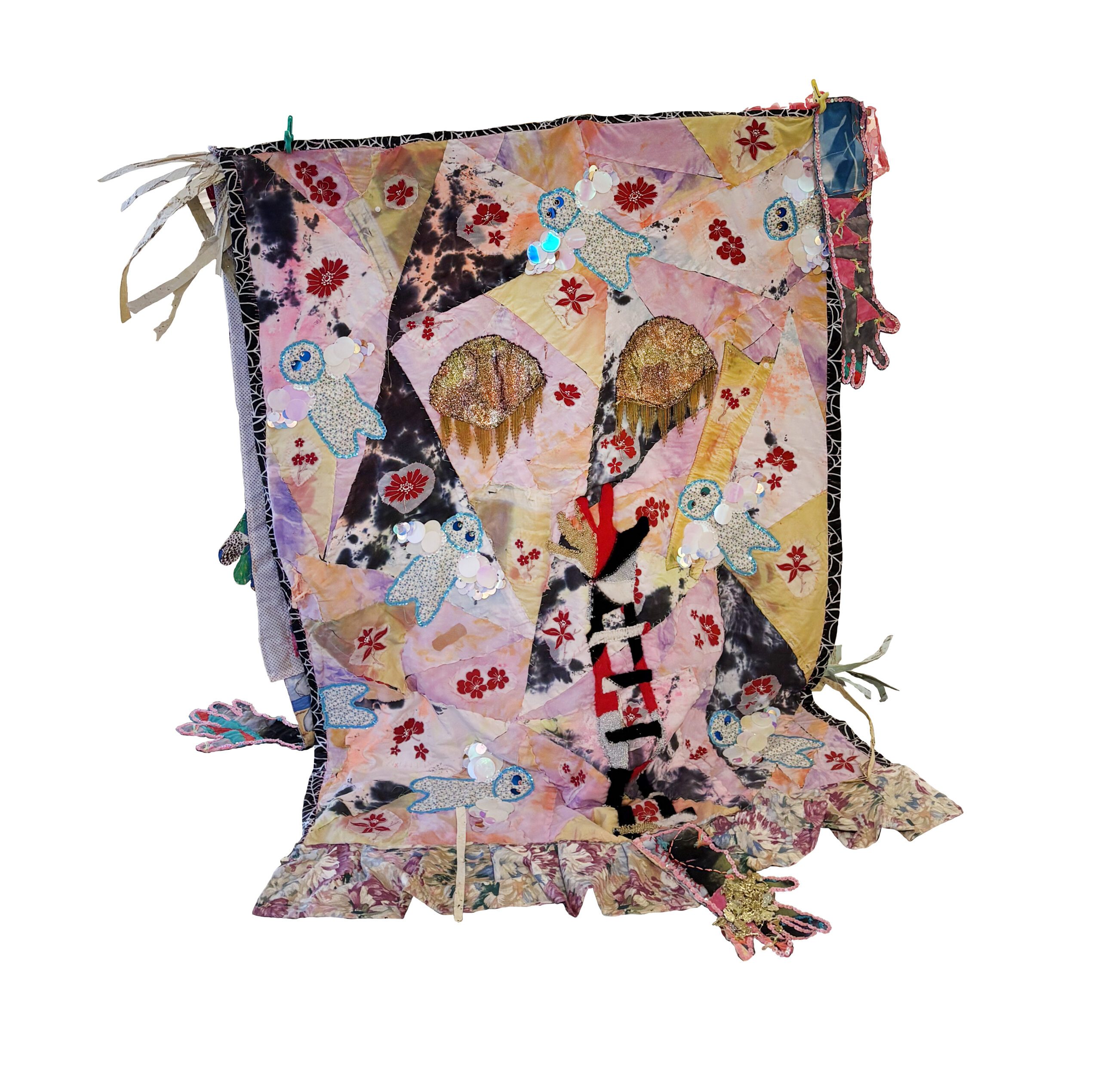
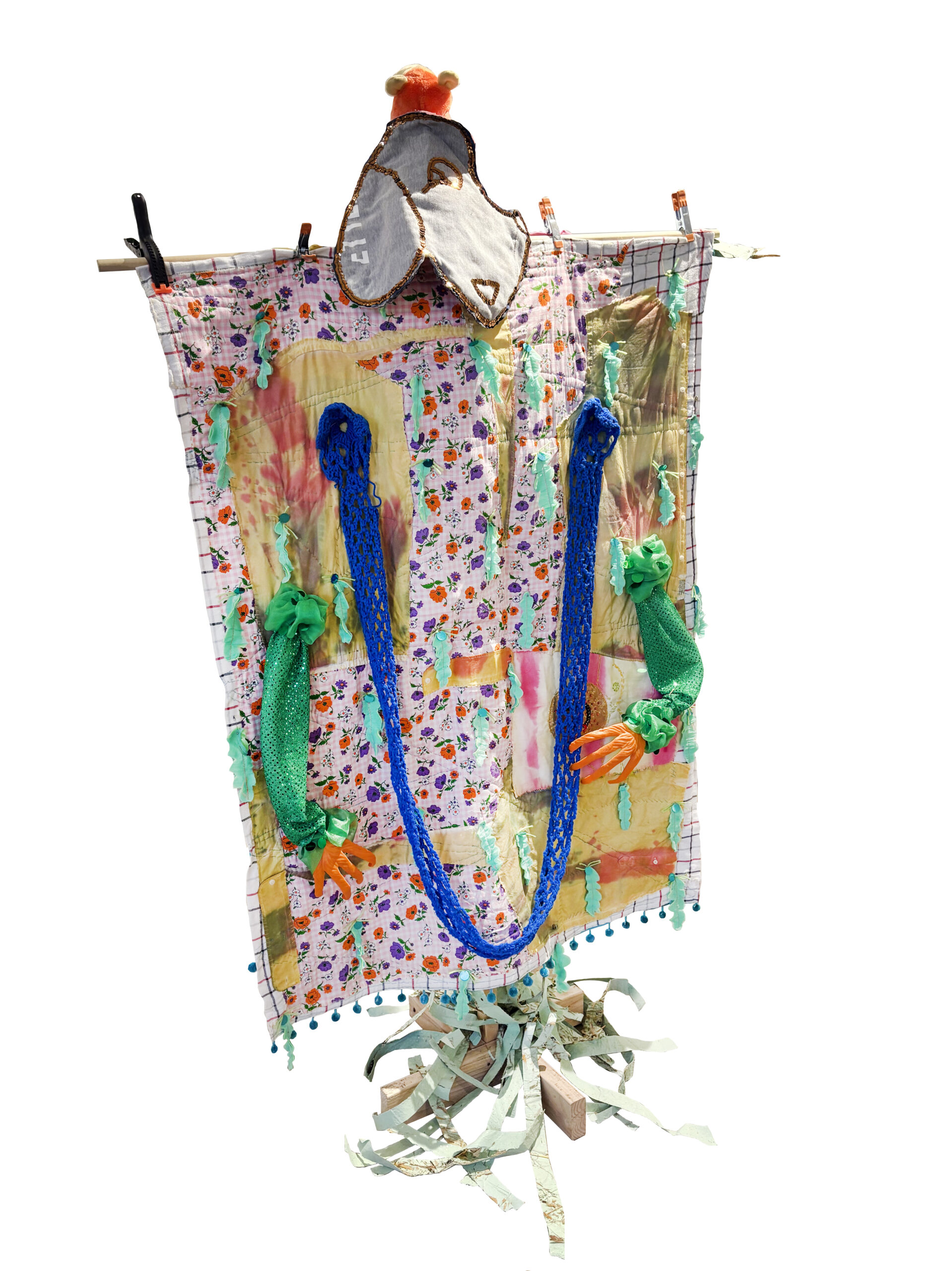
“Using personal secrets, queer history, and gay boy glamour, my work builds a world for my audience to enter.”
– Eric Anthony Berdis
Eric Anthony Berdis’ work simultaneously celebrates the contributions of queer artists and reflects on the violence and oppression that has lingered and continues to linger throughout queer history. This juxtaposition of celebration and reflection is evident in their childlike play of materials and connections to queer art history. Happiness and play are vital to survival, and Berdis, being a queer artist themself, is no stranger to this. They note “joy is an act of resilience—a critical method of subverting hegemonic narratives of suffering.”
Eric Anthony Berdis’ Paper Bullies and Friends of Dorothy’s is being exhibited in our Community Arts gallery.
Alicia Finger, Painting
Tile Gallery
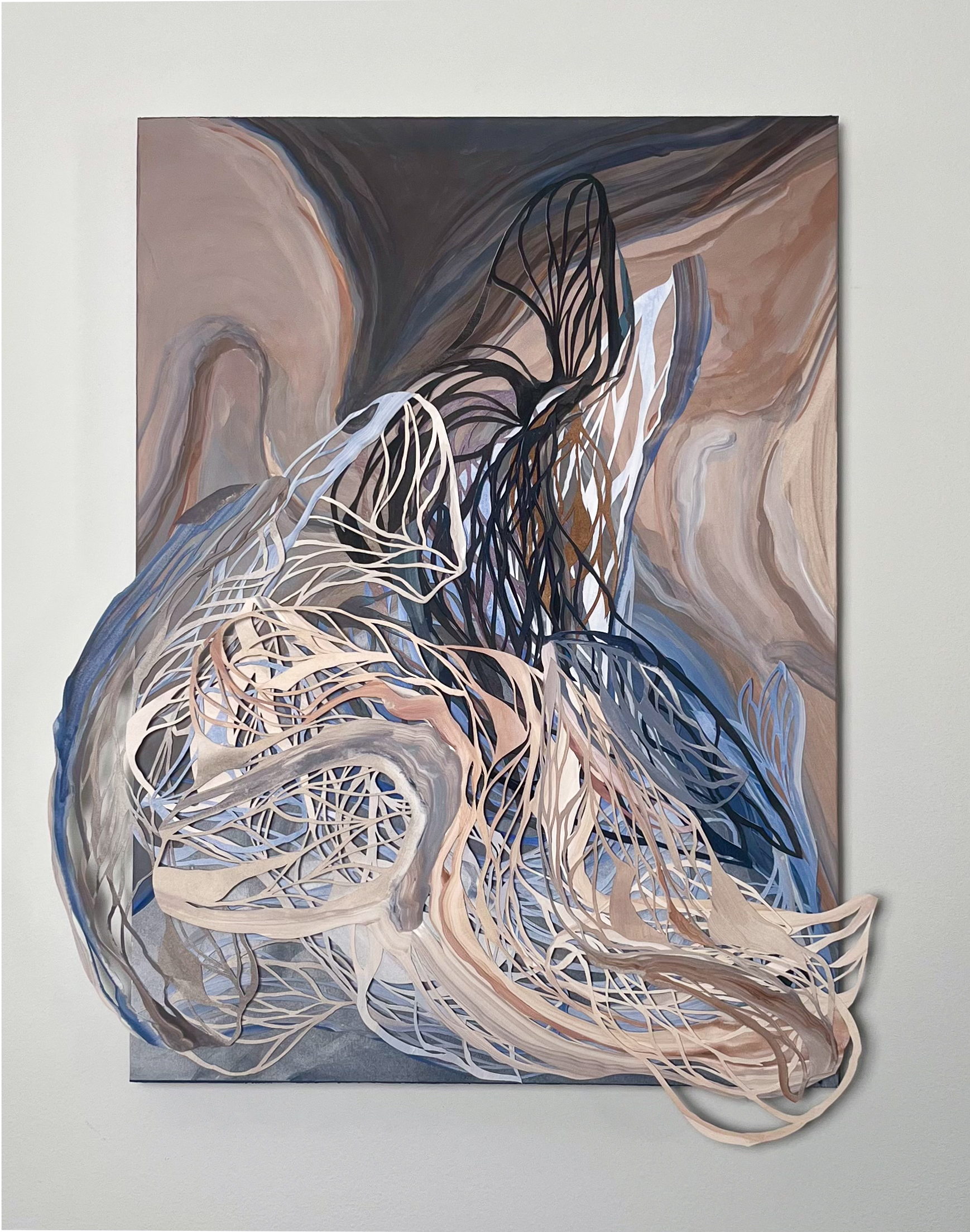
| Acrylic on cut paper, collage, $1,025
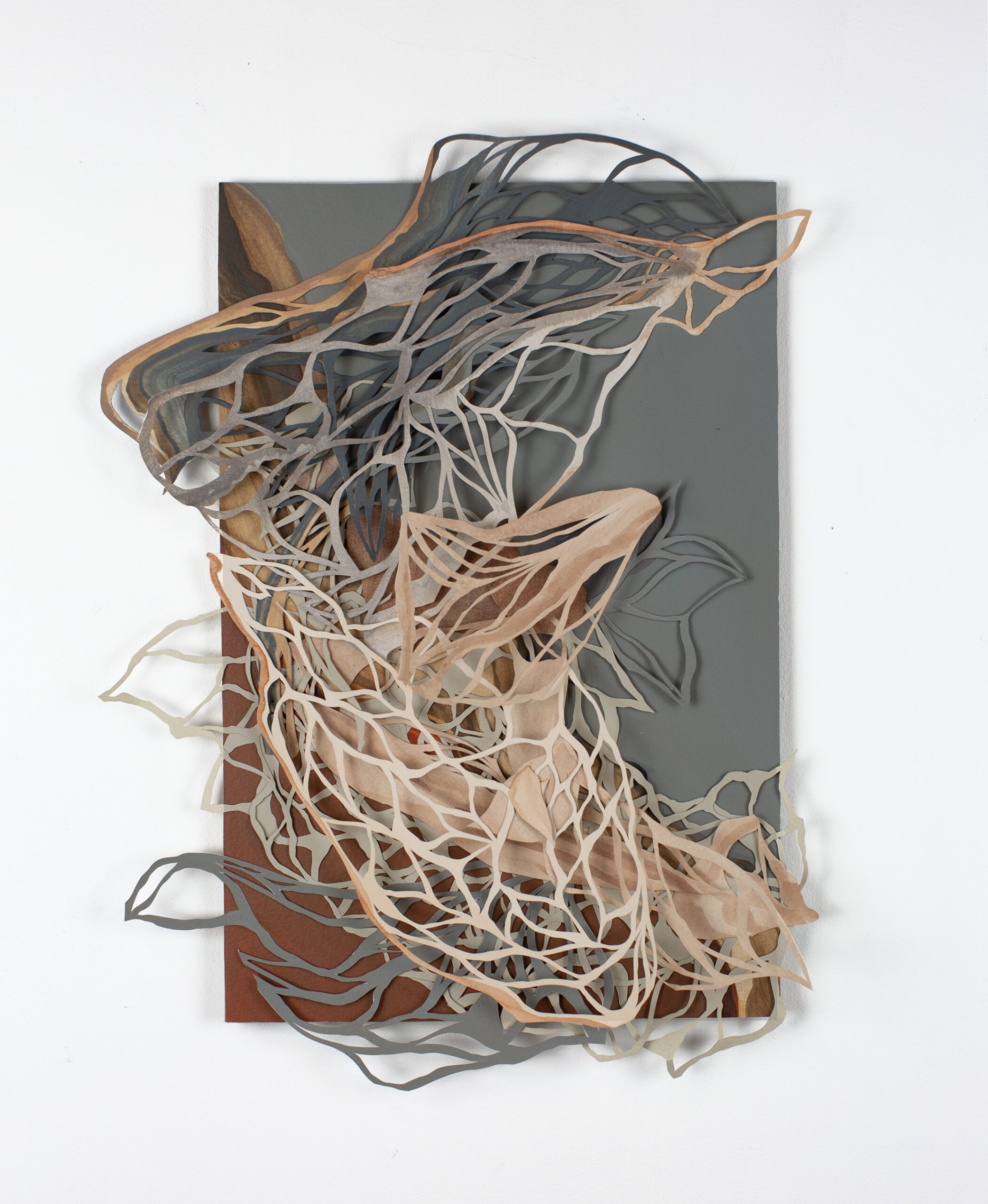
| Acrylic on cut paper, collage, $625
“Each piece has gone through a range of stages and appearances, reemerging as different works each stage.”
– Alicia Finger
Alicia Finger encapsulates her memories and visits through a combination of painting and collage. Using water-based paints, Finger begins by developing a series of paintings on paper, inspired by places she has been to. She then begins the meticulous process of cutting, rearranging, and layering the material to create dimensional paintings that break beyond the bounds of the paper plane. This evolution parallels memory, noting “as my memories of these places and experiences evolve, so do these works.”
Alicia Finger’s Reconstructed Places is on view in our Tile gallery.
Jenna Hannum, Mixed Media
Kellner Gallery

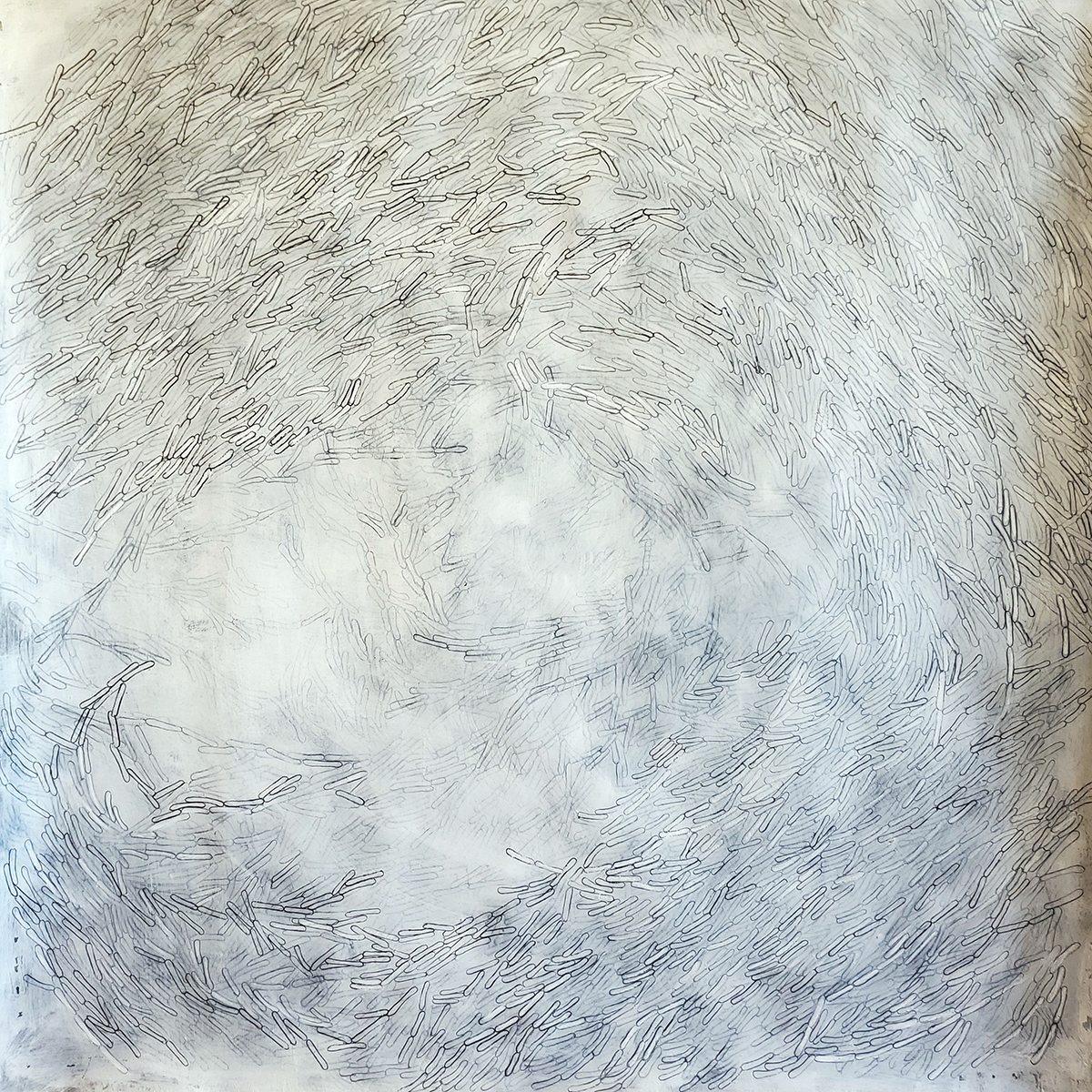
“These new portraits on paper and linen, combinations of fine art and craft, are an elegy to the women I’ve lost and a way to retroactively be a caregiver through drawing and embroidery.”
– Jenna Hannum
Jenna Hannum combines scientific illustration with unconventional portraiture to catalog childhood memories, family medical histories, and the biological journeys of loved ones. Following the tragic passing of both her mother and sister, her work stems from her desire to have spent more time as a caretaker. “Creating ink from the ashes of medical records and repurposing the tangible items left behind by [her] mother and sister”, Hannum’s careful renditions allow her to retroactively be a caregiver, even posthumously.
Jenna Hannum’s Elegy is on view in our Kellner gallery.
Kate Strachan, Mixed Media
Book Room Gallery
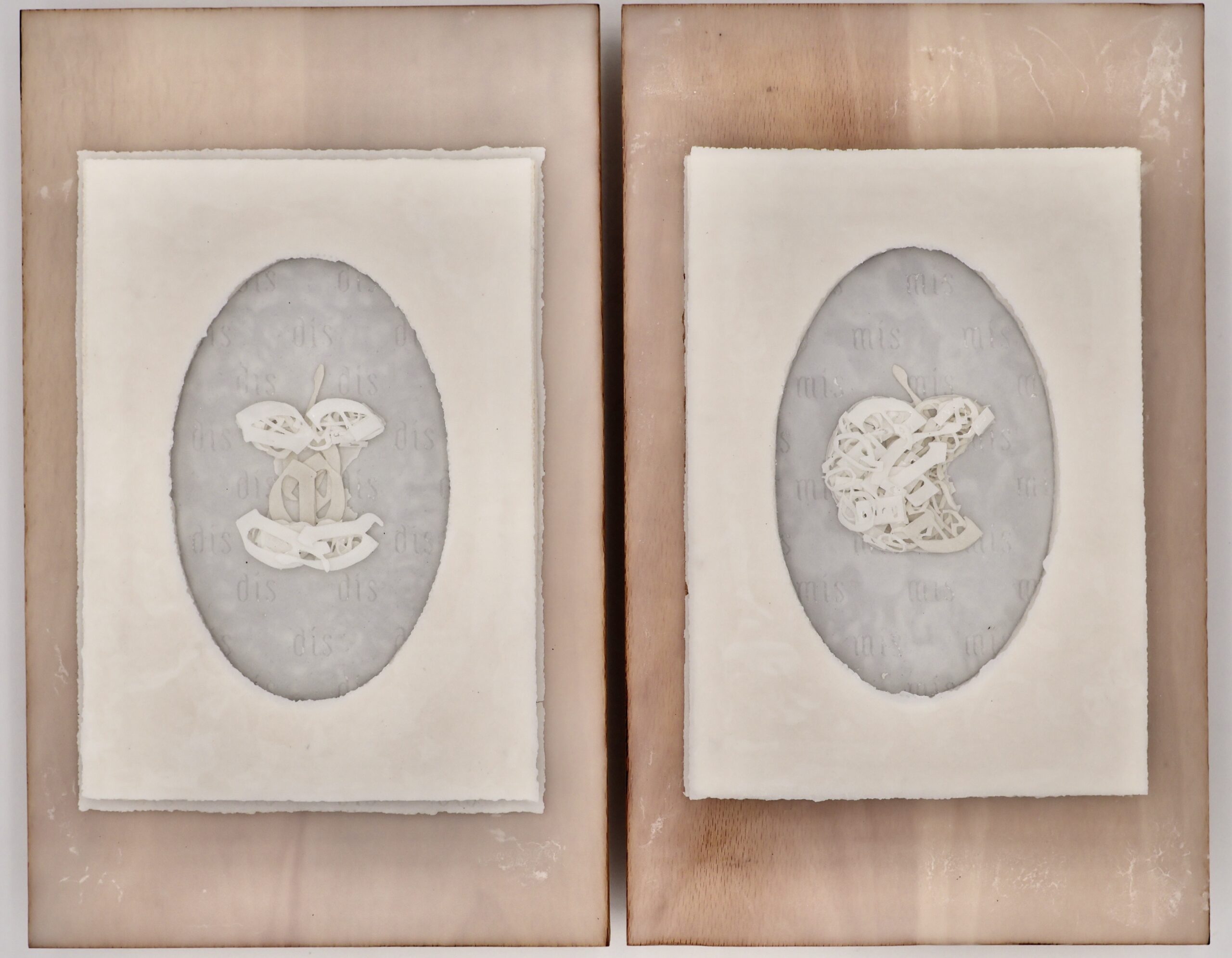
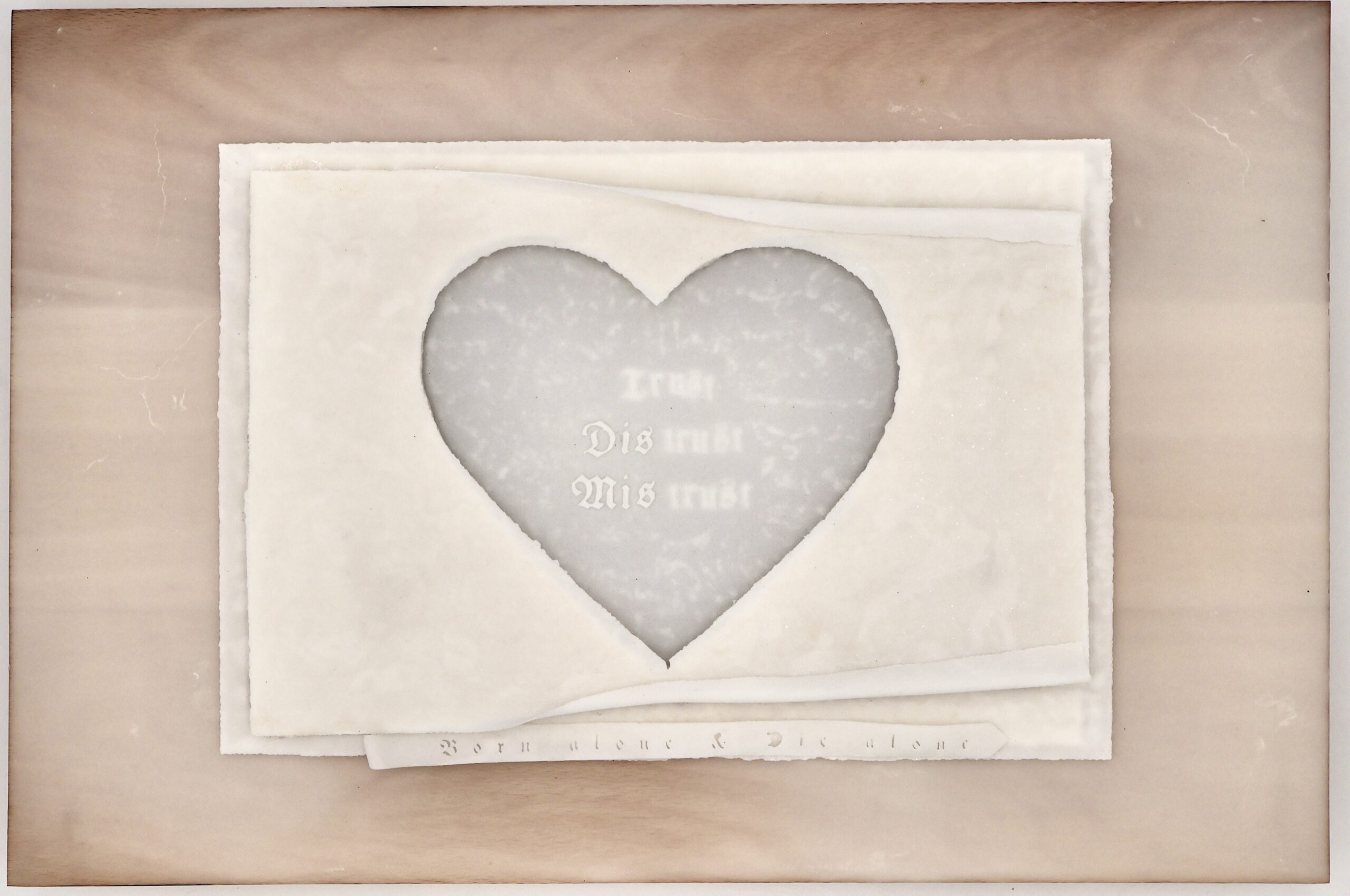
“Our artwork serves as a curiosity cabinet, a repository where we place ourselves within the collected fragments of our existence. Much like the rooms we inhabit, our creations become filled with impressions of our identities and experiences.”
– Kate Strachan
Using a blend of materials—wax, wood, ceramic, and felt—Kate Strachan draws upon her Pennsylvania Dutch heritage to create work that comprises relics and manuscripts that convey and preserve the rituals of action, sexuality, and silence. Her artwork reflects the ancestral manuscripts that detail life, death, spiritual poetry, and house blessings, typical of Pennsylvania Dutch Frakturs. With an emphasis on materiality, Strachan notes, “I weave together ceramic for its fragility and coolness, felt for its capacity to evoke silence, wax for its encaustic technique symbolizing preservation, and wood for its primal origins…Through these materials, I tell my own story, layering meaning and texture to explore the depths of human experience.”
Kate Strachan’s I n v i s i b l e Sight is on display in our Book Room gallery.
For inquiries about work in our exhibition, please contact acook@abingtonartcenter.org.
High in Fiber: A Fiber Arts Exclusive Exhibition
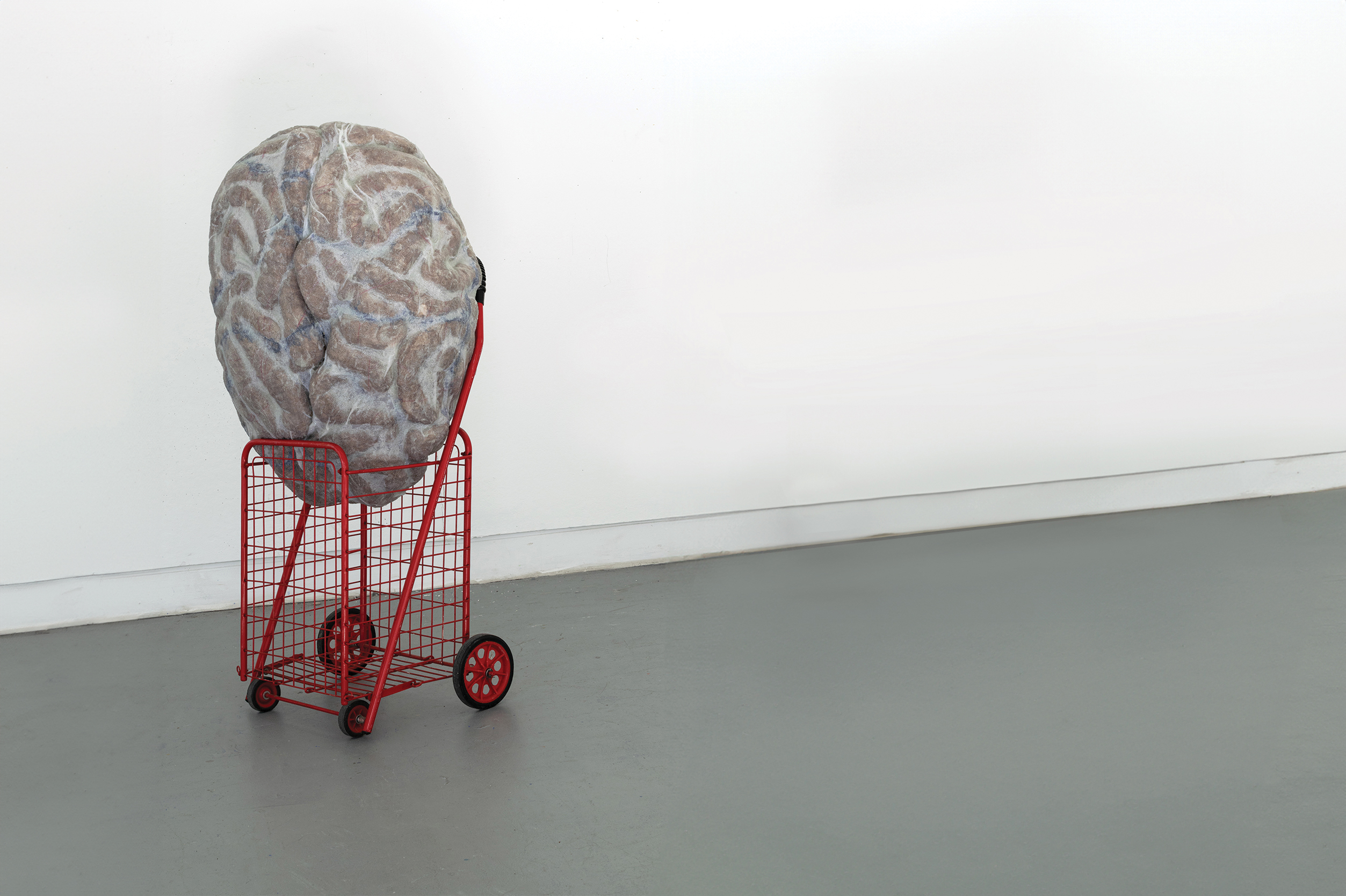
On View November 8, 2024 – January 6, 2025
Opening Reception | Friday, November 8 | 6:00p.m. – 8:00 p.m.
High in Fiber: A Fiber Arts Exclusive Exhibition
High in Fiber is a fiber arts exclusive exhibition showcasing the versatility and complexity of the fiber medium, from its rich history to its unique characteristics as a material.
Fiber arts, also known as textile arts, is considered to be both a new and old form of art. Historically, fiber arts is one of the oldest art forms. Dating back tens of thousands of years, this form of art was born out of necessity and served a practical purpose over an aesthetic one. Coupled with the understanding that fibers and textiles were historically the domain of women, fiber arts has been strongly associated with domesticism and was deemed as “lesser art”. The efforts of feminist artists during the 1970s feminist movement pushed fiber arts into the realm of high art and helped the medium become what it is today: a form of fine art.
High in Fiber is on display in our Kellner, Book Room, and Tile galleries from November 8, 2024 – January 6, 2025.
High in Fiber Juror:
THECOLORG
Philadelphia-based Fiber Artist
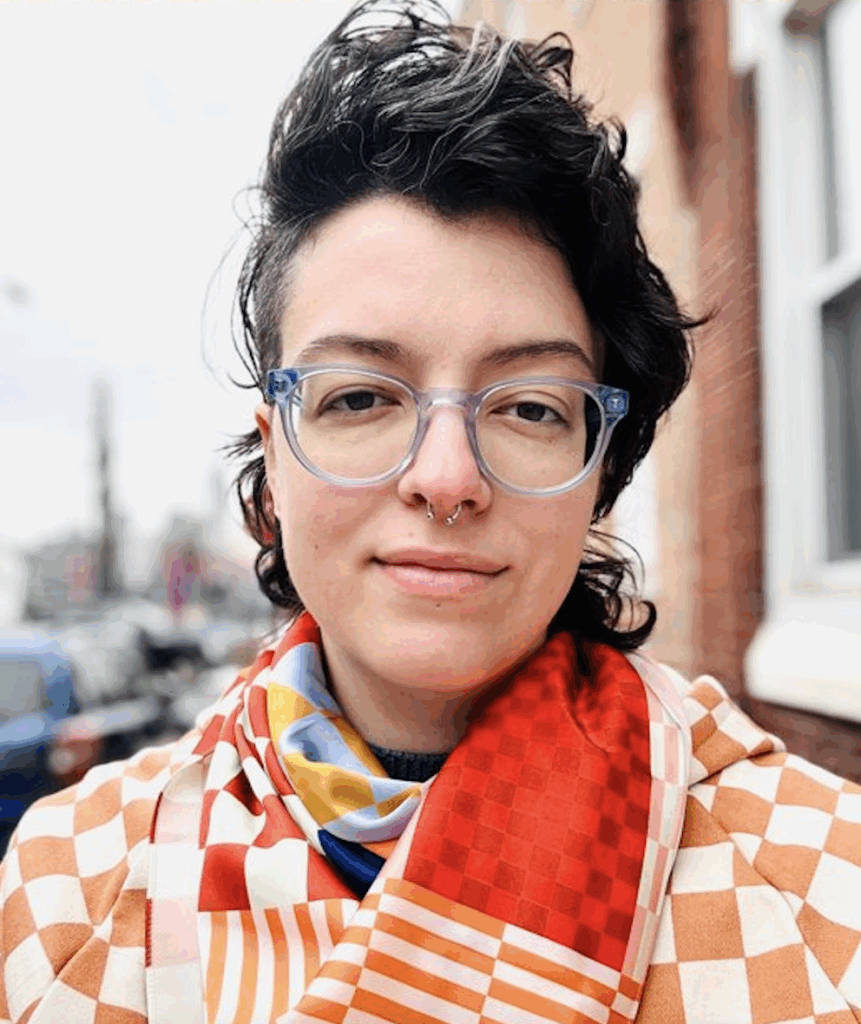
THECOLORG is an interdisciplinary artist and professional arts administrator based in Philadelphia, PA. They received their MFA from the Pennsylvania Academy of the Fine Arts and their BFA from Edinboro University of Pennsylvania.
Through soft sculpture, installation, and painting, THECOLORG’s work reflects the bridge between childhood memories and adult experiences, using objects and materials that evoke a sense of familiarity and introspection.
Juror’s Statement
“As the juror for High in Fiber, I was inspired by the diversity of fiber-based artworks submitted
for consideration. The exhibition showcases a broad range of materials and techniques,
including wood fiber, recycled fibers, paper, trash, yarn, plastic, found objects and even animal
hide. Each artist’s unique approach to the medium demonstrates how fiber can be reimagined in
contemporary art practice, from traditional quilting and crochet to sculptural and conceptual
works.
While I aimed to curate an exhibition that highlights this expansive use of fiber, I was struck by a
recurring theme that emerged organically: the bodily experience. Many of the works in this show
reflect a connection to the human body, whether through materials, form, or narrative. This
connection feels deeply rooted in the history of fiber itself. Fiber is arguably one of the oldest, if
not the oldest, art forms known to humanity. It was first used to clothe and protect us from the
elements, offering both warmth and shelter. Over time, it evolved into a medium through which
we express identity, culture, and shared human experience.
This inherent link between fiber and the body remains palpable in the works exhibited. Whether
they address themes of protection, vulnerability, or identity, the artworks remind us of the
material’s primal function while pushing the boundaries of its application in contemporary art.
The variety and creativity of the submissions have made this exhibition an inspiring testament to
fiber’s enduring relevance and adaptability. I hope visitors will appreciate the complex ways
these artists have harnessed fiber to tell new stories and engage with the body in fresh,
thought-provoking ways.”
Exhibiting Artists
Nini Adelsberger
Bren Ahearn
Jen Ahearn
Margery Amdur
Tithi Arekar
Lucy Beizer
Kristina Bickford
Gail Biederman
Lynda Grace Black
Brooke Cassady
Genevra Daley
Kabita Das
Valerie Dillon
Hyunsuk Erickson
Korissa Frooman
Elena Gans-Pfister
Valerie Goodman
Heidi Jensen
Lena Kolb
Kelly Lawler
Jeanine LeBlanc
Krystle Merchant
Amanda Milz
Liz Quay
Maddie Rodriguez
Teresa Shields
Jacquelyn Strycker
Rachel Blythe Udell
Kathryn Jenson White
Flora Wilds
Julie Woodard