The Lutz Tower
From Community Member,
David Bell
Capt. David Bell is a Master Mariner, author, and teacher of navigation, seamanship, and boating safety. His published credits include books and articles on celestial navigation, boat handling, marlinespike skills, and ecology. A volunteer streamkeeper in the Tookany Creek Watershed, he resides at 75° 8′ 45″ West Longitude.
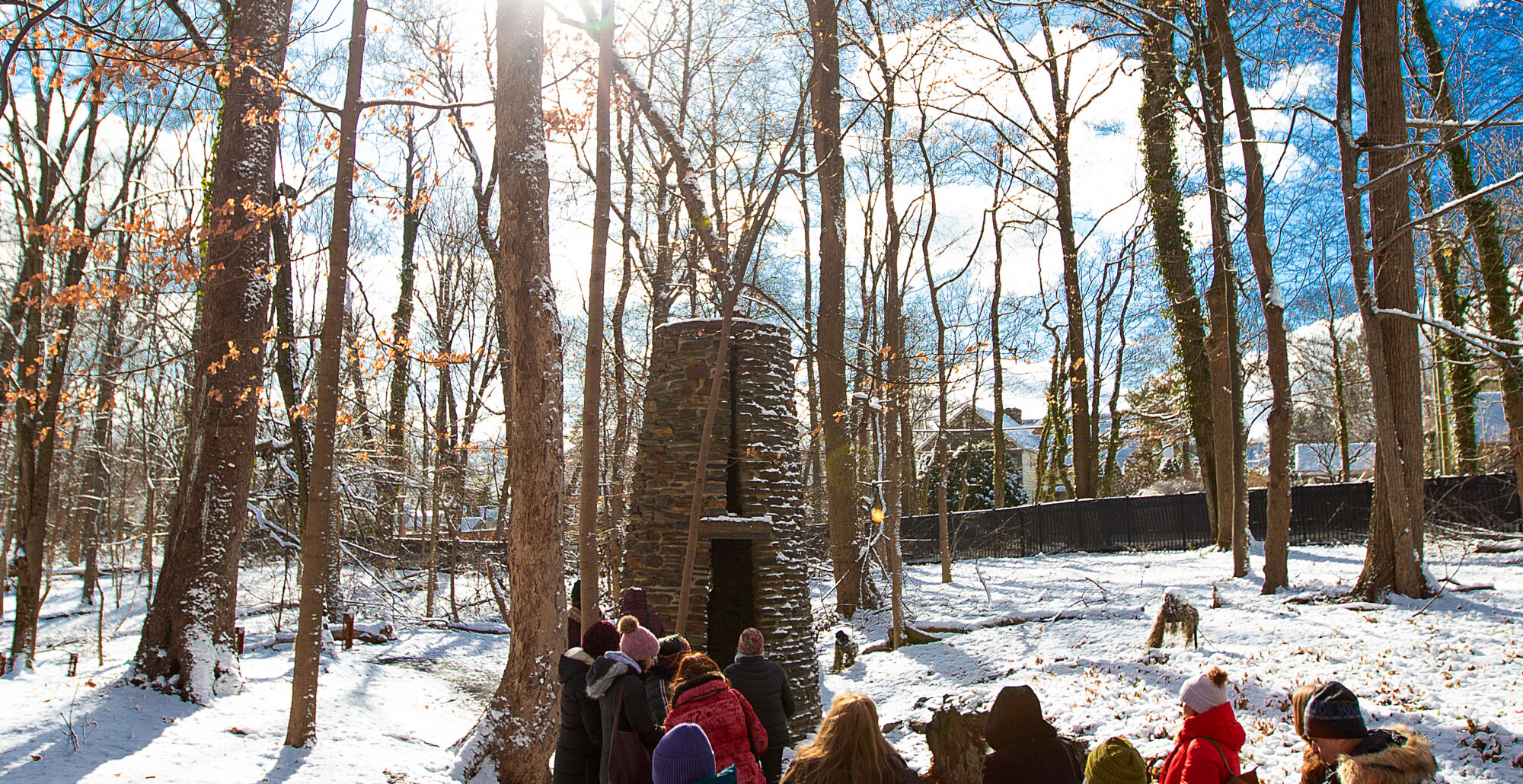
The Winifred Lutz Tower at Abington Art Center provides visitors with the opportunity to observe the sun’s passage every day that the sun casts a shadow.
As the apparent motion of the mid-day sun moves from east to west (left to right), a shaft of sunlight crosses the floor of the tower from right to left. The time at which the shaft of sunlight bisects the floor marks the sun’s meridian passage.
Also known as Local Apparent Noon (LAN) or Solar Noon, meridian passage is when the sun is over the observer’s meridian of longitude. It’s also at its highest altitude of the day.
The Winter Solstice happens when the sun is over the Tropic of Capricorn. The time that occurs depends on the sun’s position over the earth, not the observer’s longitude. The 2025 Winter Solstice took place at 10:03 am, Eastern Standard Time. The next Summer Solstice, when the sun is over the Tropic of Cancer, will be on June 21, 2026 at 4:24 am, Eastern.
Because because LAN depends on the observer’s longitude, it doesn’t necessarily happen exactly at noon everywhere in a given time zone. For example, the difference in longitude between Lancaster, Pa., and the Lutz Tower is a little more than one degree, and Lancaster is to the west, so it will experience LAN almost 5 minutes later. Since the day isn’t exactly 24 hours long, LAN doesn’t happen at the same exact time every day. Also, Daylight Savings changes LAN by one hour, local time.
The result is that LAN can occur at 11:40 am, 1:03 pm, or even 11:58:24, for example. It’s possible to calculate the time of LAN using the Nautical Almanac and converting arc to time, but thankfully, The National Oceanic and Atmospheric Administration (NOAA) provides an online Solar Calculator at https://gml.noaa.gov/grad/solcalc/ . Just drag the red pin to any location, enter the date, and the calculator will give you the times of sunrise, sunset, and solar noon.
All this means that you can enjoy the splash of sunlight on stone at the Winifred Lutz Tower and mark solar noon on the day of the Winter Solstice or any other day the sun is out at Abington Art Center.”