
Events
Solo Series Winter 2026
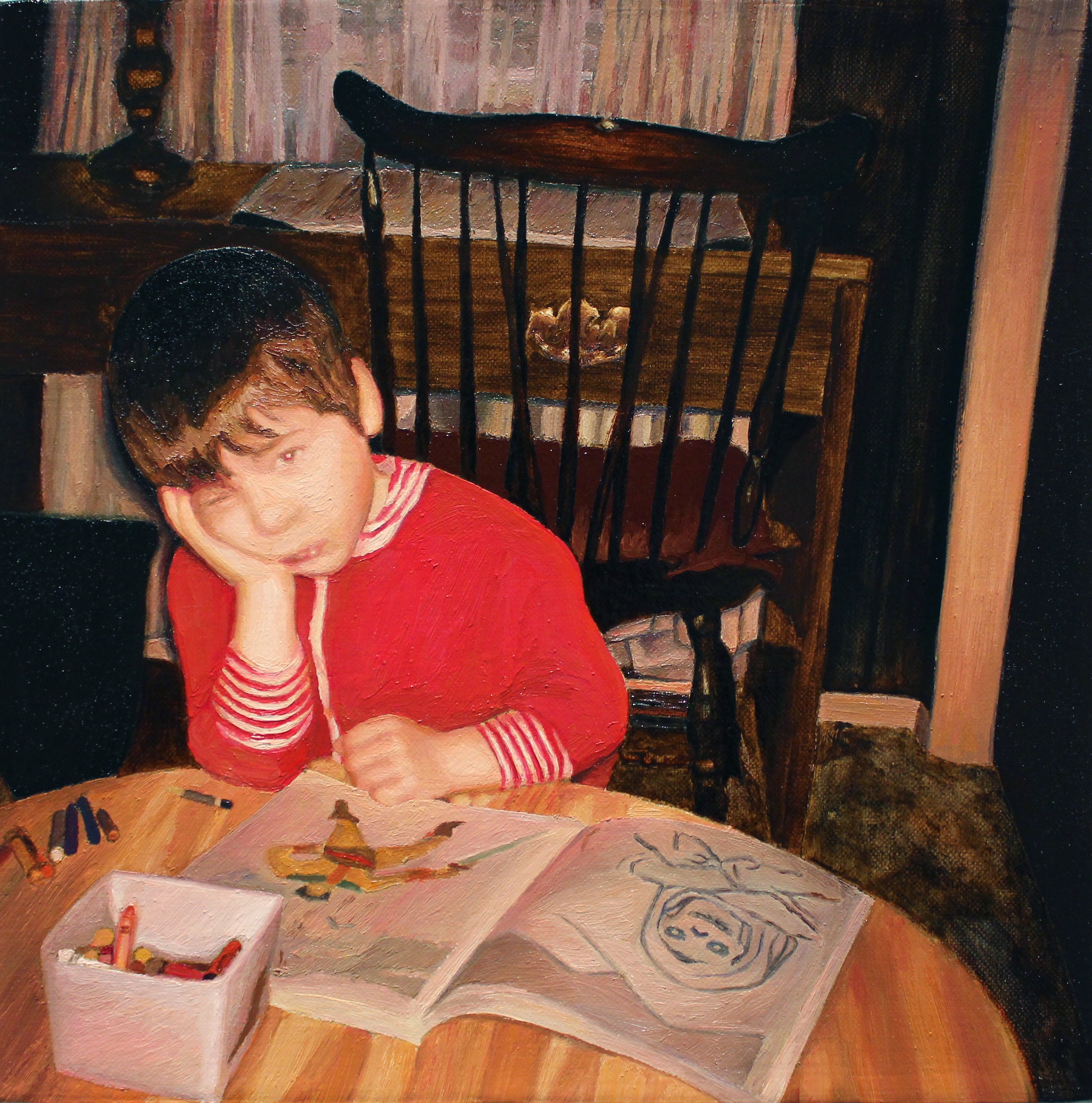
Event
Coloring Book, 2023 | Ezra Thompson | Oil on linen
On View Jan. 16 – Feb. 23, 2026
Opening Reception | Friday, Jan. 16 | 6:00p.m. – 8:00 p.m.
Artist Talk | Michelle Marcuse | Wednesday, Feb. 4 | 6:00 p.m. – 8:00p.m.
Featured Artists: Michelle Marcuse, Ezra Thompson, and Karen Cooper
ARTISTS
Michelle Marcuse – Fray
Kellner Gallery

“Emerging from the slopes of Table Mountain in Cape Town, where apartheid’s shadow cut through my childhood innocence, I learned early that beauty and brokenness are not opposing forces, but interconnected narratives that I can reimagine. Alongside my brother, we constructed elaborate tales of make-believe worlds from the overgrown African outdoors. This became my first topography of repair as we collectively pieced together our imaginary environments, unconsciously practicing rebuilding a fractured world. My childhood seemed idyllic, but the ever-present specter of South Africa’s politics loomed in the background. Since then, I have continued to wrestle with the potential for harmony and discord to co-exist simultaneously.
My practice has become an extension of these early impulses: to create environments, transform brokenness and reimagine possibility. Characterized by fragmented compositions, my work is defined by the presence of my hands as both a destructive and constructive force. Working in abstraction, I blend real perspective with areas of flat pattern, forming hybrid, textured landscapes. Creating form is like solving a puzzle; each piece evolves through experimentation and discovery. Process is central to my practice, and I prefer to innovate over technical proficiency. Guided by a deliberate yet restless inquiry, I explore the tension between rhythmic delineation and negative space. Materials — wire, raffia, string, and found cardboard— are chosen for structural malleability. These everyday items reflect the contradictions feeding my work, oscillating between states of value and insignificance. Moving from earth to factory, they become commercial waste that I translate into abstract form. Whether large and free-standing or small and wall-mounted, the act of constructing material leaves behind messy remnants—visible layers of texture that keep my work in flux. In a world increasingly drawn to perfection, these are important to me as I seek evidence of human touch and its inherent vulnerability.
Through aleatory connections and pattern recognition, I trace the hidden architectures of chaos, making visible the intricate markings that connect and transform—leaning into complexity, and holding its contradictions alongside its aspirations, reassembling both materials and hope itself.”
— Michelle Marcuse
Michelle Marcuse is a South African-American artist whose work explores the contradictions that shape our perception of reality, often influenced by the lens of cultural heritage. Born in 1957 in South Africa, she immigrated to the United States in 1984, establishing herself in Philadelphia where she maintains an active studio in Fishtown. Marcuse holds a Bachelor of Design from The Shenkar College of Engineering and Design in Israel and a BFA in painting from Tyler School of Art in Philadelphia.
Her work has been exhibited in solo and group shows at prestigious venues including the Corcoran School, BLAM Projects, Taller Boricua, Little Haitian Cultural Center, Art Life Foundation, and Restart Museum in China. In 2024, Marcuse became a resident artist at the Brandywine Print Workshop, where she collaborated with Master printmaker Alexis Nutini. That same year, she participated in (re)FOCUS/2024, a significant citywide exhibition celebrating the 50th anniversary of Philadelphia Focuses on Women in the Visual Arts. Marcuse is also a 2025 recipient of an Anonymous Was A Woman award—an unrestricted grant awarded annually to 15 woman-identifying artists over 40 at a critical junction in their career.
Notable earlier exhibitions include Cultivated Spaces at Rowan University (2022), which examined socio-economic, cultural, and environmental concerns in creative practices; Arte y el Amor at Taller Boricua, NYC (2016), where she exhibited alongside her partner in a show exploring how relationships sustain artistic practices; and Borderless Caribbean at the Haitian Cultural Arts Alliance in Miami (2015), which investigated the fluidity of thoughts, materiality, and cultural exchange.
A CFEVA Fellow alumni and Joan Mitchell Foundation shortlist honoree, Marcuse’s work resides in several collections, including The Philadelphia Art Museum. Her commitment to fostering an artistic community extends beyond her studio practice—she previously served as co-director of HouseGallery, a community-based art space in her residence in Fishtown. Marcuse is also a 2025 recipient of an Anonymous Was A Woman award—an unrestricted grant awarded annually to 15 woman-identifying artists over 40 at a critical junction in their career.
════════════════════════════════════
Ezra Thompson – The Kid Stays in the Picture
Tile Gallery
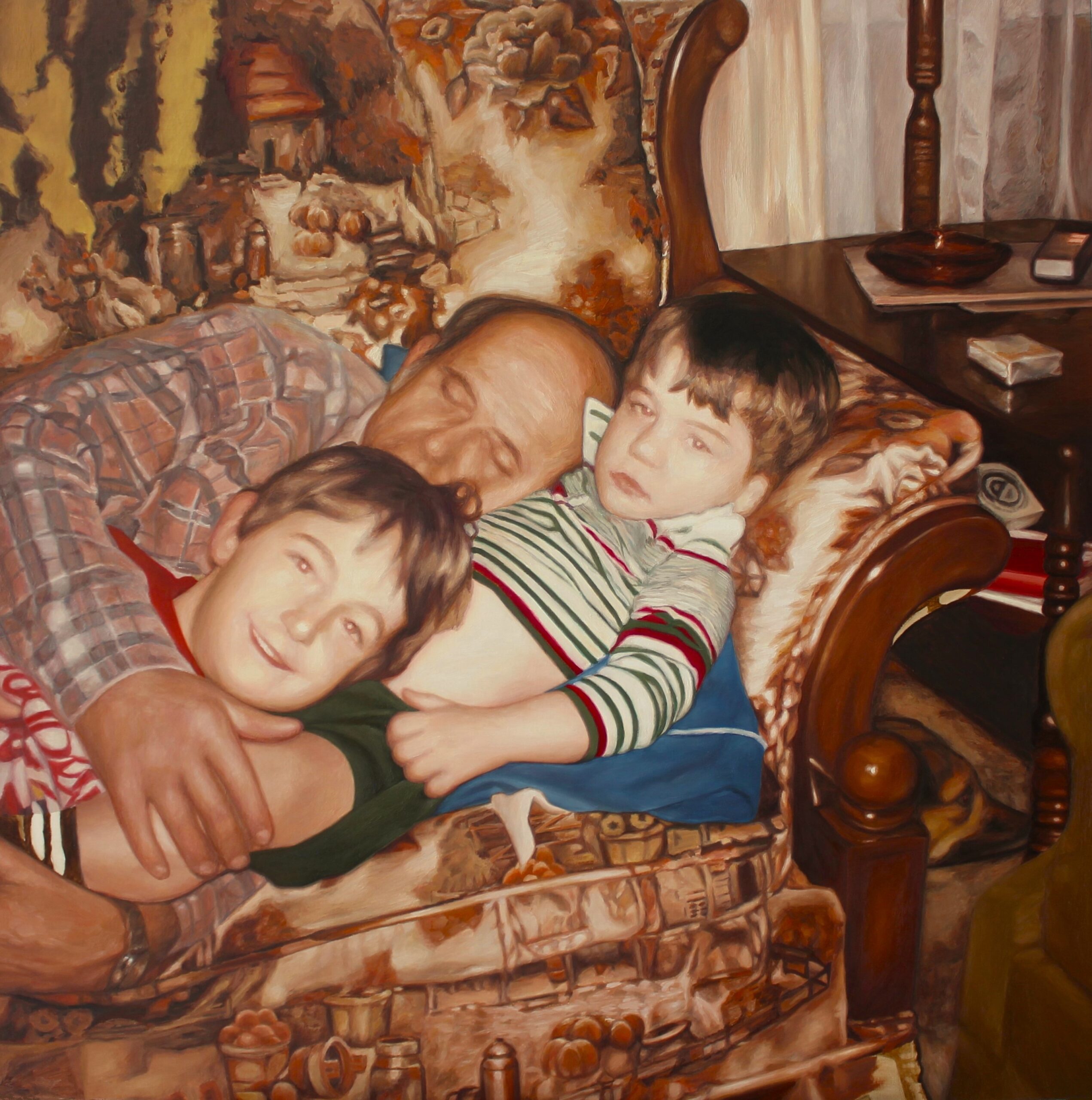
“My recent paintings have been concerned with the theatre of memory. In revisiting memory and the past through the photograph, I am attempting to re-learn the use of ‘signs’ to understand and communicate reality. Beginning with the snapshot, I select everyday experiences of life that appear to be instantly unfolding. The initial awkwardness of the subject is only secondary to my larger concern — the experience of loss and exclusion: loss of loved ones, loss of affection, friendship, and innocent joy. In creating this body of work, there is an attempt to recapture that loss and thus save it from destruction. It is only through this re-visitation of the photograph in adulthood that one hopes to ‘fill in’ or at least ‘pick up the pieces.’ The painting thus becomes a true remembrance of things past.”
— Ezra Thompson
Ezra Thompson is an artist whose work navigates abstraction, surrealism and realism, exploring the intricate forces that shape identity and the complexities of self-perception. Through his paintings, Thompson engages in a dialogue between the conscious and subconscious, the personal and the universal.
Ezra has attended residencies at the Vermont Studio Center and Aljira Emerge in Newark, New Jersey. He was granted the American Scandinavian Foundation Fellowship and a Rothenberg Fellowship for projects in Copenhagen and Berlin, respectively. His work has been exhibited at the Parrish Art Museum, Heckscher Museum of Art, Ferrara Showman Gallery, Gallery 263, Greenwich Art Society and other venues in the Greater New York region. Most recently his work was selected for the White Columns Curated Artist Registry. He has also served as a Curatorial Intern at the Whitney Museum of American Art and held a position as a Conservation Assistant at the Frick Collection’s Art Reference Library in New York City.
Thompson received a BFA from The Cooper Union (NYC) and an MFA in Studio Art from Stony Brook University (NY), where he is currently a Lecturer in the Department of Art. He is based in Long Island, NY.
════════════════════════════════════
Karen Cooper – kozukuri – small works
Book Room Gallery
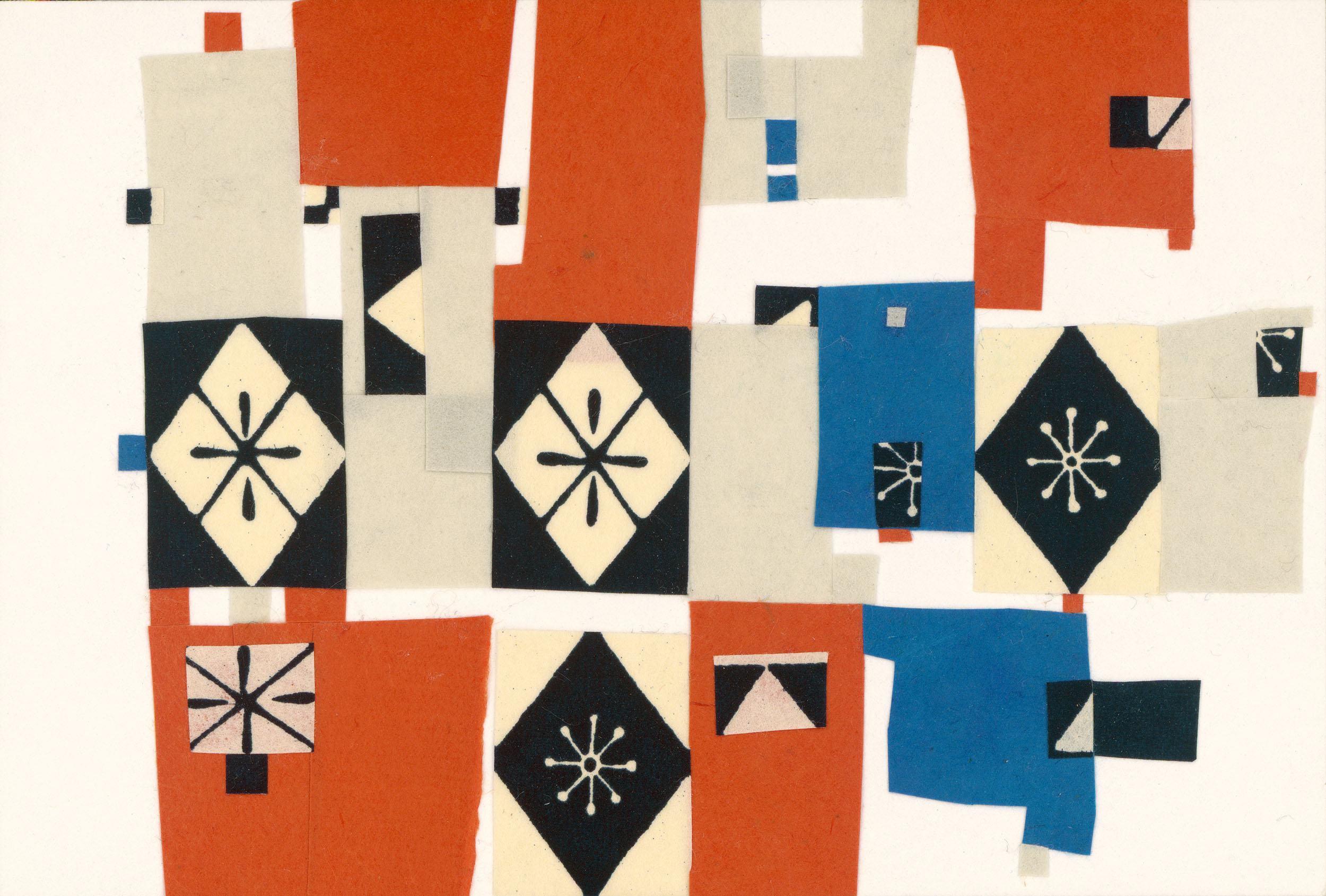
“My work is quiet. I take a meditative approach. My desk is cluttered with fractured pieces, but then I’ll take a piece and put it next to another and it begins to tell me something… to tell a story. When I add the next element the story may change. Sometimes, as I add to the story, finding the next element becomes more and more difficult. I’ll put the work aside for days, weeks or months. Then, suddenly, the solution will appear, like an insight that solves a mathematical puzzle. The work contains color and form, but also white space, which plays an equally powerful and important role. I recently started to add thread to collages as a connective tool; a way to help the eye move around the work in a balanced way.”
— Karen Cooper
Karen Cooper has a background in graphic design, having completed coursework through The School of Visual Arts and studying closely with graphic designers, Dale Moyer, Ed Benguiat, and Roger Ferriter. She built a business as a freelance mechanical artist, which involved the precision manual assembly of type and images before the advent of computer-based graphics, and worked for graphic design companies including: Bernhardt/Fudyma Graphic Design; Vignelli & Associates; Nautical Quarterly; Upper & Lower Case; Peckolick & Associates and Sothebys. Cooper then founded her own studio as a graphic designer, working primarily with corporate health care hospitals and service providers in the New York Metropolitan area.
Karen Cooper began to work with hand-dyed cloth, composing abstract pieces using quilting techniques, but it wasn’t until moving to Japan for two years that she grew an interest in handmade washi paper—an element that remains evident in her work. She experiments with small, abstract collages incorporating found paper, washi paper, thread, cloth, and other everyday materials.
════════════════════════════════════
For inquiries about work in our exhibitions, please contact our Gallery Manager at acook@abingtonartcenter.org.